
The AI Efficiency Paradox: When Cheaper Tokens Trigger a Hardware Arms Race
In the history of technology, efficiency is almost never a synonym for contraction. When a resource becomes dramatically cheaper to produce, the market does not neatly pocket the savings and walk away. It finds ways to consume that resource at a scale previously considered absurd.
Cheaper bandwidth did not reduce the amount of copper and fiber we laid; it birthed streaming video and pulled the world into the cloud. The cost of computing has plummeted for sixty years, yet we spend exponentially more on data centers today than we did in 1990.
AI is currently undergoing a massive efficiency cycle. Investors, watching the unit cost of inference collapse, are understandably asking if the great GPU buildout is over. But a closer look at the telemetry of modern AI clusters reveals a different reality. AI efficiency is not eliminating infrastructure demand. It is changing the location of scarcity.
The Wrong Question
Investors keep asking whether AI efficiency will reduce GPU demand. The better question is: when AI gets cheaper, where does the saved capacity go?
Right now, efficiency is acting as a massive demand absorber, taking the freed capacity and instantly filling it with vastly more complex workloads. And while the total pie continues to grow, the real disruption is a value-capture shift: the migration of profit away from the raw merchant GPU and toward custom silicon, memory systems, advanced networking, and application routing.
The Boring Software Layer
When markets look for efficiency, they usually look for a new chip. But the most immediate, economically disruptive efficiency gains of the last 12 months haven’t required a single new piece of silicon. They are purely software-driven.
Runtime optimization improves the throughput of existing clusters. But that is not the same as making the cluster unnecessary. A serving stack that improves batching, reduces KV-cache waste, or increases token throughput.... does not remove the accelerator from the system. It increases the amount of useful work that accelerator can perform. In a market where demand is still constrained by capacity, that usually raises utilization before it reduces orders.
Continuous batching keeps GPUs fuller across requests, but more throughput usually gets filled by more inference.
Prompt and prefix caching avoid recomputing repeated context, but the savings depend on cache-hit rates.
KV-cache reuse reduces memory waste, but longer context can consume the savings.
Quantization fits more work into the same HBM footprint, but quality validation limits universal deployment.
Speculative decoding speeds decode when draft acceptance is high, but it is less useful when acceptance rates are low or batch sizes are high.
FlashAttention and kernel optimization reduce memory I/O bottlenecks, but the bottleneck often just moves elsewhere.
The Two Costs Hidden Inside Every Query
The important technical detail is that inference is not one workload. It has at least two very different phases:
Prefill Phase: The system reads the prompt and context, building the initial state. This makes memory bandwidth, attention efficiency, and context length critical.
Decode Phase: The model generates tokens one at a time. This makes latency, GPU utilization, and KV cache reads critical.
A breakthrough that improves one phase may do little for the other. A model can become more efficient in prefill while still being decode-bound, or it can speed up decode while long-context memory pressure explodes. This is why “cost per token fell” is an incomplete market signal. The better question is whether the full production workflow now needs fewer GPUs, less HBM, less networking, less cooling, and less power. So far, the evidence says mostly no.
The Infrastructure Flywheel
The paradox is that efficiency can increase the value of the next unit of infrastructure.
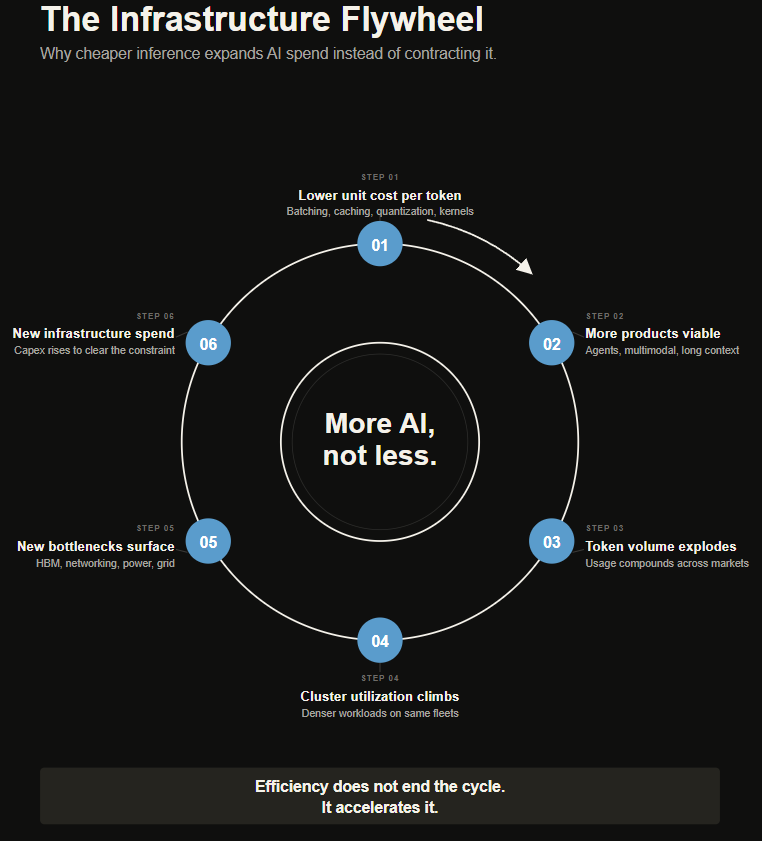
When inference becomes cheaper, more products become economically viable. When more products become viable, usage rises. When usage rises, operators need higher cluster utilization. Higher utilization increases memory and networking pressure. Higher density increases cooling and power requirements. Those constraints then justify the next round of system-level investment.
That is the infrastructure flywheel: Lower unit cost → more use cases → higher usage → higher utilization → new bottlenecks → new infrastructure spend.
This is why the AI buildout can continue even as the cost of intelligence falls. The system is not spending more because it failed to become efficient. It is spending more because efficiency made more demand possible.
Bottleneck Migration
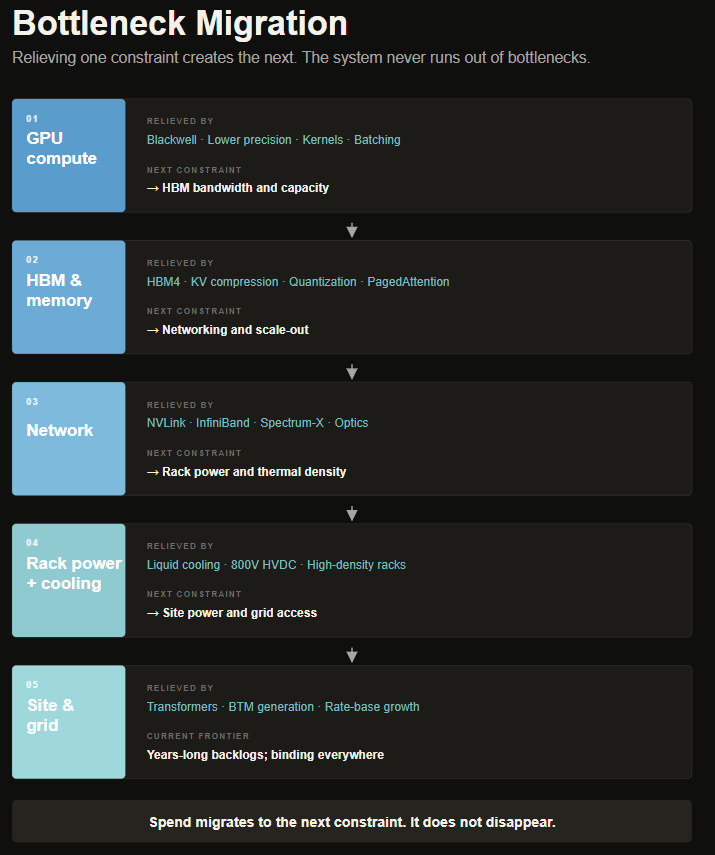
AI efficiency does not remove the bottleneck. It relocates it. The constraint moves from GPU utilization → HBM → networking → cooling → power.
HBM is where the efficiency paradox becomes physical. A model does not only need arithmetic; it needs to move weights, activations, and KV-cache state through memory at enormous speed. Long-context inference makes this worse because every active request carries a growing memory footprint. When serving software increases throughput, the system can process more concurrent requests, but those requests still need memory capacity and bandwidth. In other words, better GPU utilization can increase pressure on HBM rather than relieve it.
Power is where the AI efficiency paradox becomes a site-level constraint. A more efficient chip can improve performance per watt, but if it also makes larger clusters economical, total site power demand can still rise. The constraint shifts from “can we buy the chip?” to “can we energize the campus?” That means transformers, switchgear, backup generation, interconnection queues, liquid cooling loops, chillers, and power distribution architectures become part of the AI supply chain. This is why power and cooling names can benefit even in a world of better chips. Efficiency increases the feasible density of compute, but density creates new thermal and electrical constraints. The buildout does not disappear; it changes shape.
The Deployment Gap: Benchmarks Are Not Invoices
A benchmark tells us what is possible under controlled conditions. An invoice tells us what is happening in production. The market gets into trouble when it treats the first as if it were the second.
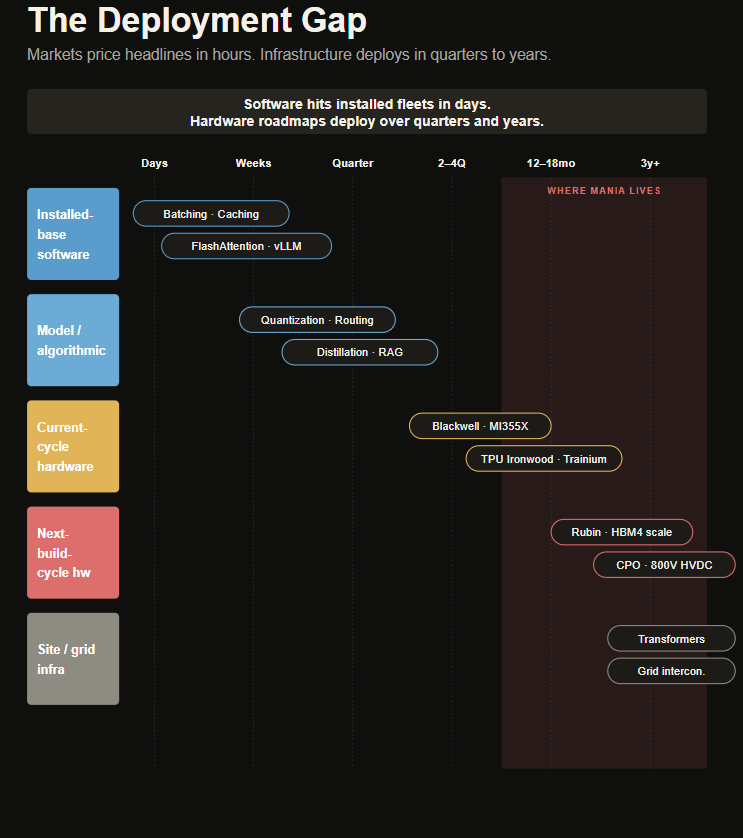
Production is constrained by batch size, latency requirements, customer behavior, model quality thresholds, uptime, memory pressure, workload mix, security/compliance, and cloud availability. Hardware roadmaps change stock prices immediately, but they change physical infrastructure slowly.
Runtime optimization (Days to quarters): Improves existing fleets and absorbs demand.
Quantization (Weeks to quarters): Lowers inference cost and may pressure generic APIs.
Model routing (Weeks to quarters): Shifts value to applications.
New GPUs (Quarters to years): Improves the next capex cycle.
HBM4 and rack-scale systems (12–36 months): Big impact, but physically constrained.
Power and cooling redesign (Years): Unlocks scale, but rarely reduces overall demand.
The Real Risk: Value-Capture Shift
The risk is not that AI infrastructure goes away. The risk is that the next dollar of AI infrastructure profit goes somewhere different from the last dollar.
Custom silicon is not a clean bearish signal for AI infrastructure. It is bearish for the idea that every unit of AI demand must flow through merchant GPU scarcity. Merchant GPUs still matter where flexibility, frontier performance, broad software support, and rapid model iteration matter. Custom silicon is most dangerous where the workload is high-volume, standardized, and controlled by the hyperscaler. That makes them a formidable threat to standardized internal inference and training, but less immediately disruptive to every frontier or enterprise workload.
More inference overall: Benefits GPUs, cloud providers, and inference infrastructure.
Longer context usage: Benefits HBM, memory systems, and KV optimization tools.
Larger, faster clusters: Benefits networking, optics, and switches.
Higher rack density: Benefits liquid cooling and power equipment vendors.
Custom silicon migration: Benefits Broadcom, Marvell, and the hyperscalers.
Better routing and specialists: Benefits application companies and orchestration layers.
Commodity token compression: Pressures undifferentiated inference APIs.
Tokens Are Not Tasks
Cost per token is a vendor metric. Cost per completed workflow is a business metric.
A token is not the economic unit; a completed workflow is. A modern AI workflow is no longer a prompt and an answer. It is often a chain: retrieve context, summarize it, call tools, reason over the results, generate an answer, test the answer, verify it, retry if needed, and log the output for audit or compliance. Each step consumes tokens, memory, latency budget, and infrastructure. That is why token deflation can coexist with infrastructure growth. The token gets cheaper, but the product gets more ambitious.
Coding agents: Token savings buy more planning, code generation, testing, debugging, and verification.
Customer support: Efficiency means more tickets automated, more context per case, and more escalation logic.
Legal review: Allows for longer documents, more retrieval, more citations, and deeper verification.
Enterprise search: Drives more sources searched, more context loaded, and more personalized answers.
Cybersecurity: Enables more logs scanned, more alerts triaged, and more automated investigation.
Finance and accounting: Funds more reconciliation, anomaly detection, and audit trails.
Scientific research: Supports more simulations, literature reviews, and hypothesis generation.
Video and image generation: Text savings get seamlessly reinvested into heavy multimodal compute.
The Financial Telemetry
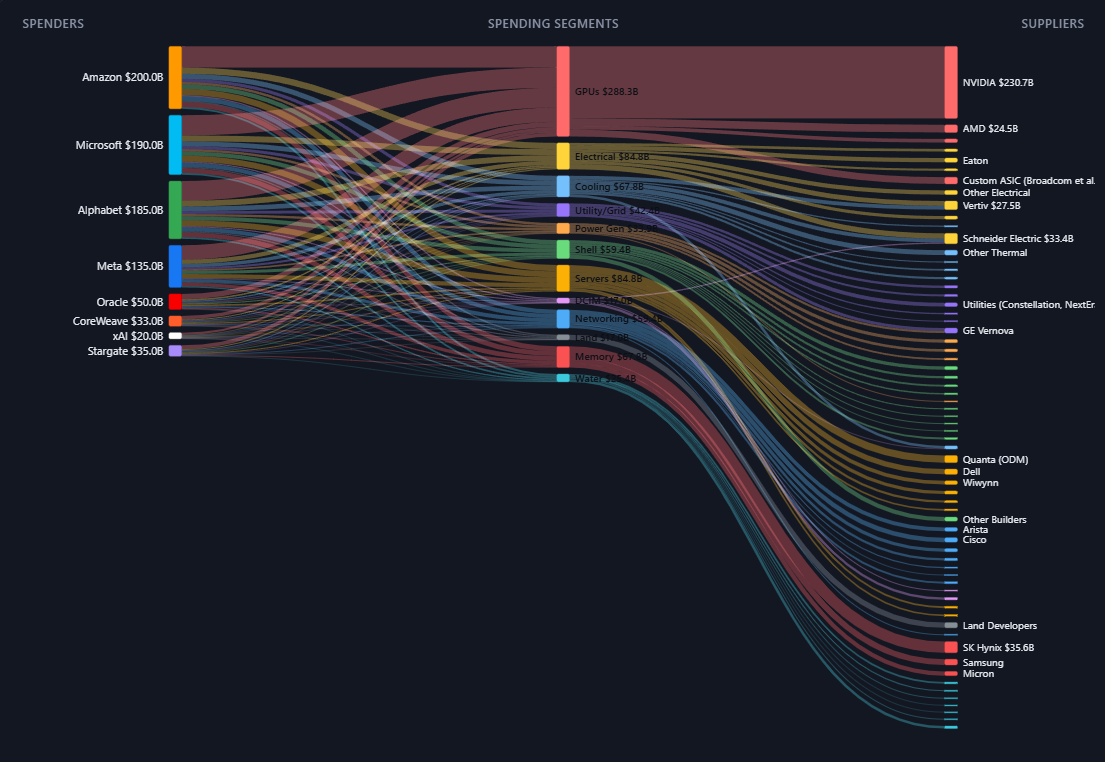
Financial statements are the closest thing we have to an invoice for the AI buildout. Benchmarks tell us what could happen. Capex, commitments, RPO, backlog, and supplier revenue tell us what is actually being built.
None of these numbers proves that efficiency is causing the buildout. They prove something narrower but important: the public financial evidence does not yet look like broad AI infrastructure deflation.
Microsoft: Indicated calendar 2026 capex of roughly $190 billion, maintaining that Azure is capacity-constrained.
Meta: Raised 2026 capex guidance to $125–$145 billion, backed by $237.7 billion in non-cancelable commitments and $182.9 billion in not-yet-commenced leases.
Alphabet: Posted $35.7 billion in Q1 capex, noting first-party models process over 16 billion tokens per minute.
Amazon: Saw property and equipment purchases jump by $59.3 billion year-over-year. AWS's custom chip business alone has topped a $20 billion annual revenue run rate.
Oracle: Remaining Performance Obligations (RPO) spiked 325% to $553 billion.
Broadcom: Generated $8.4 billion in Q1 AI semiconductor revenue, largely driven by custom accelerators and AI networking.
These are not the signatures of a market where efficiency is already shrinking infrastructure demand. They are the signatures of a market where efficiency is making more AI economically viable faster than the supply chain can respond.
https://michaelpjob.github.io/aiCAPEX/index.html
What Would Change the Thesis
A good thesis should be falsifiable. If AI efficiency is truly becoming capex deflation, the evidence should eventually show up not in a benchmark chart, but in the physical and financial system. Actual capex deflation would require a cluster of evidence:
Hyperscaler AI usage continues rising, but AI capex flattens or declines.
GPU orders are pushed out specifically because of efficiency gains.
HBM pricing weakens despite strong AI usage.
Data-center leasing softens.
Used GPU supply rises materially.
Cloud providers show rising AI revenue with falling capex intensity.
Enterprises move large workloads to smaller routed models at scale.
Inference prices fall faster than usage grows.
We are not seeing that cluster yet.
The Dashboard
If you want to track where the market is heading, use this watch list:
Demand absorption signs: Watch for rising capex, HBM tightness, growing cloud AI revenue, heavy power queues, and token volume growth.
Capex deflation signs: Watch for order pushouts, HBM pricing softness, surging used GPU supply, and easing data-center leases.
Value-capture shift signs: Watch for TPU/Trainium/Maia/MTIA adoption, Broadcom AI revenue, and AMD enterprise wins.
Mania signs: Watch for stocks rerating purely on roadmap claims long before deployment evidence exists.
Conclusion
The market’s mistake is not believing in efficiency. Efficiency is real. The mistake is assuming the savings all accrue in one place. In reality, the savings are competed over. Some go to cloud margins. Some go to lower prices. Some go to application owners through routing. And much of it is reinvested into more context, more reasoning, more agents, and more multimodal workloads.
AI efficiency is real. But real does not mean deflationary.
In the near term, efficiency improves utilization and expands demand. In the medium term, it shifts value capture toward custom silicon, memory, networking, power, cooling, and orchestration. In the long term, it may deflate specific pockets of infrastructure spend, especially standardized inference workloads.
But the broad evidence today does not point to an AI buildout that is ending. It points to a buildout whose bottlenecks are moving.
The investment question is not whether AI gets cheaper. It will. The question is whether cheaper AI means less infrastructure, more AI, or a different set of winners.
Right now, the answer looks like: more AI, different winners, and a market that will keep confusing those two things.