Blocs Over Substrate
Part 4 of "Counting Chips": the chip war didn't end. It was absorbed into a contest of blocs. Every bloc stands on the same constrained ground.
In October 2025, one of the world's leading AI labs did something that, on the standard map of the chip war, makes no sense. Anthropic committed to buy access to as many as one million of Google's TPU chips: more than a gigawatt of computing, built on the silicon of the company whose Gemini models compete directly with Anthropic's Claude.¹
It was not a defection. Rather Anthropic had already deepened its partnership with Amazon, whose Trainium chips power a giant Anthropic data-center campus in Indiana, and it remained a significant Nvidia customer throughout.² One buyer, three supposedly rival platforms, major commitments across all of them, announced in the cheerful dialect of companies describing exactly what they intended all along.
Then, in May 2026, an even stranger sentence appeared in Nvidia's quarterly highlights: Google Cloud, it noted, would help power Gemini with Nvidia systems, including Vera Rubin.³ Google, owner of the industry's longest-deployed custom AI accelerator, committing to run its flagship model partly on the merchant platform its own chips let it avoid. Announced by the rival, as good news, for both.
The mechanism behind the mystery is the subject of this essay. Multi-platform procurement at this scale is policy, not confusion: at the portfolio level, competing platforms have become complements for the largest buyers, the way an airline runs both Boeing and Airbus fleets. Even as the platforms remain substitutes for any given workload. Which means the standard map fails at its central assumption. You cannot read demand off declared allegiance anymore. Demand didn't fall; by nearly every measure it exploded. What changed is the route it takes to reach a supplier, and the route arrives through three mechanisms, introduced as the map needs them.
Demand didn't fall. The route changed.
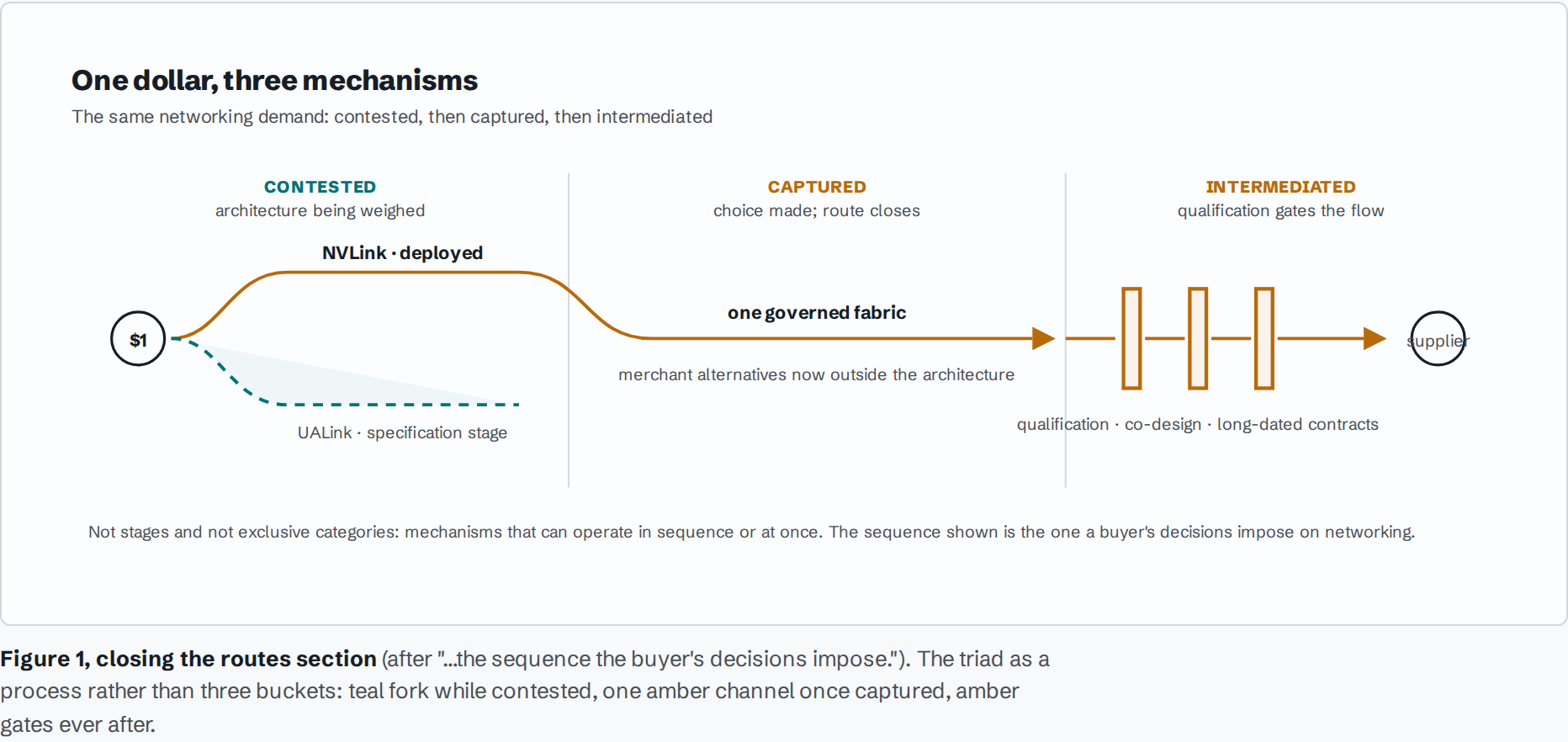
The old component markets were relatively separable: memory, CPUs, networking, and storage interacted through shared cycles, but each had its own demand curve and its own price. Meeting mainly at the customer's loading dock. The package era replaced that separability with three mechanisms that transform demand on its way to a supplier. They are not stages and not exclusive categories; the same dollar can pass through all three, as the networking example below shows.
Captured demand is demand whose destination the architecture has already decided. Define it by market accessibility, not ownership. Nvidia's Vera Rubin NVL72 platform pairs its GPUs with thirty-six of Nvidia's own Vera CPUs per rack; across the fleets that host Trainium. AWS deploys its own Graviton CPUs and Nitro infrastructure silicon. Google fields Axion in the fleets its TPUs occupy.⁴ Vera, Graviton, and Axion sit in three different ownership models, and from the outside supplier's chair the effect is identical: the CPU demand is real and growing... but the socket opportunity closes before any component-level purchasing decision occurs. The buyer still decides plenty, but at the architecture level, where the CPU arrives pre-chosen. The implication is what makes the mechanism matter. The server CPU market has not vanished, and Intel's troubles have several causes besides this one. But a growing share of AI-system CPU deployment is routed around the merchant market entirely, and within this generation of architectures, no manufacturing turnaround reopens a socket the design has already filled. If merchant silicon returns to these systems, it will be because a boundary moved, not because a bake-off was won.
Intermediated demand reaches its supplier only through gates: qualification, co-design, long-dated contracts. Qualification is not new in servers or memory; the package era intensified it. Part 2 told the story from inside the HBM stack: qualification became customer-specific, co-design reached further upstream, contracts lengthened, and the cost of missing a window grew from a lost quarter toward a lost generation. The demand is larger than ever; it simply arrives with conditions attached, and for qualified AI memory, spot prices describe a shrinking share of the volume that matters.
Contested demand is demand whose route is still being fought over, before the architecture is chosen. Networking is the live case, and it is really two contests. Inside the accelerator domain, the scale-up fabric: NVLink's deployed, governed interconnect faces UALink, a consortium-governed alternative still at the specification stage. Across racks and clusters, the scale-out network: Ethernet and its Ultra Ethernet extension are contesting ground where InfiniBand remains widely deployed. One dollar of networking demand can be contested while a buyer weighs architectures, captured once the choice is made, and intermediated ever after through the winner's qualification regime: the three mechanisms operating on a single stream, in the sequence the buyer's decisions impose.
Three blocs, and one trying to be born
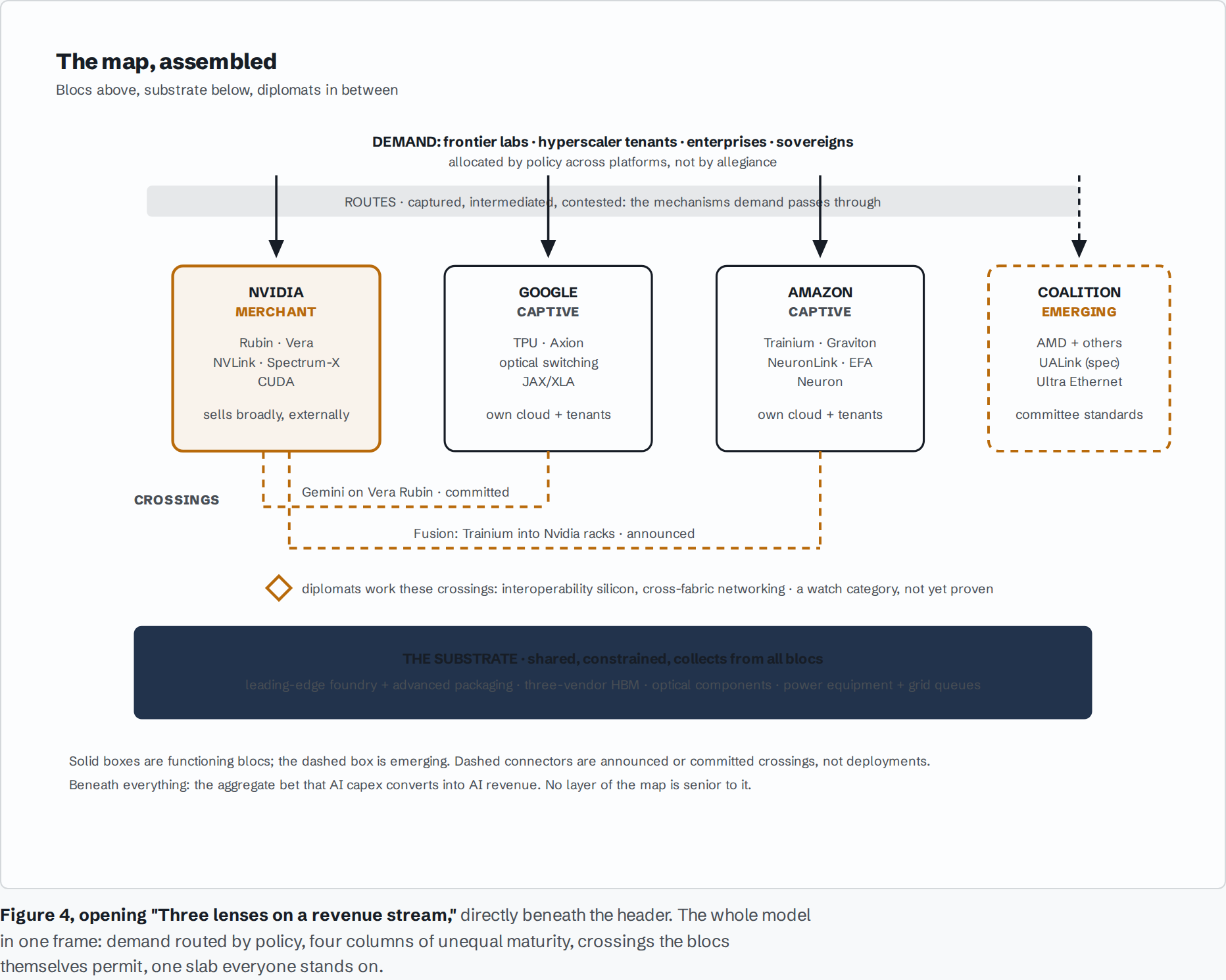
Demand routed this way changes what competes with what. The competitive object has outgrown the product: rivalry now runs between governed platforms rather than between isolated components, and corporate authority has become more central to competition, not less, because a few companies now coordinate more of the stack. Call such a platform a bloc: accelerator, host CPU, scale-up fabric, scale-out networking, and software, under a governance system, corporate or consortium, capable of binding specifications, qualifying suppliers, and repeating production deployments. By that definition three exist, and a fourth is trying to be born.
Status as of mid-2026. Component rows show component maturity; the last two rows assess the stack as a whole.
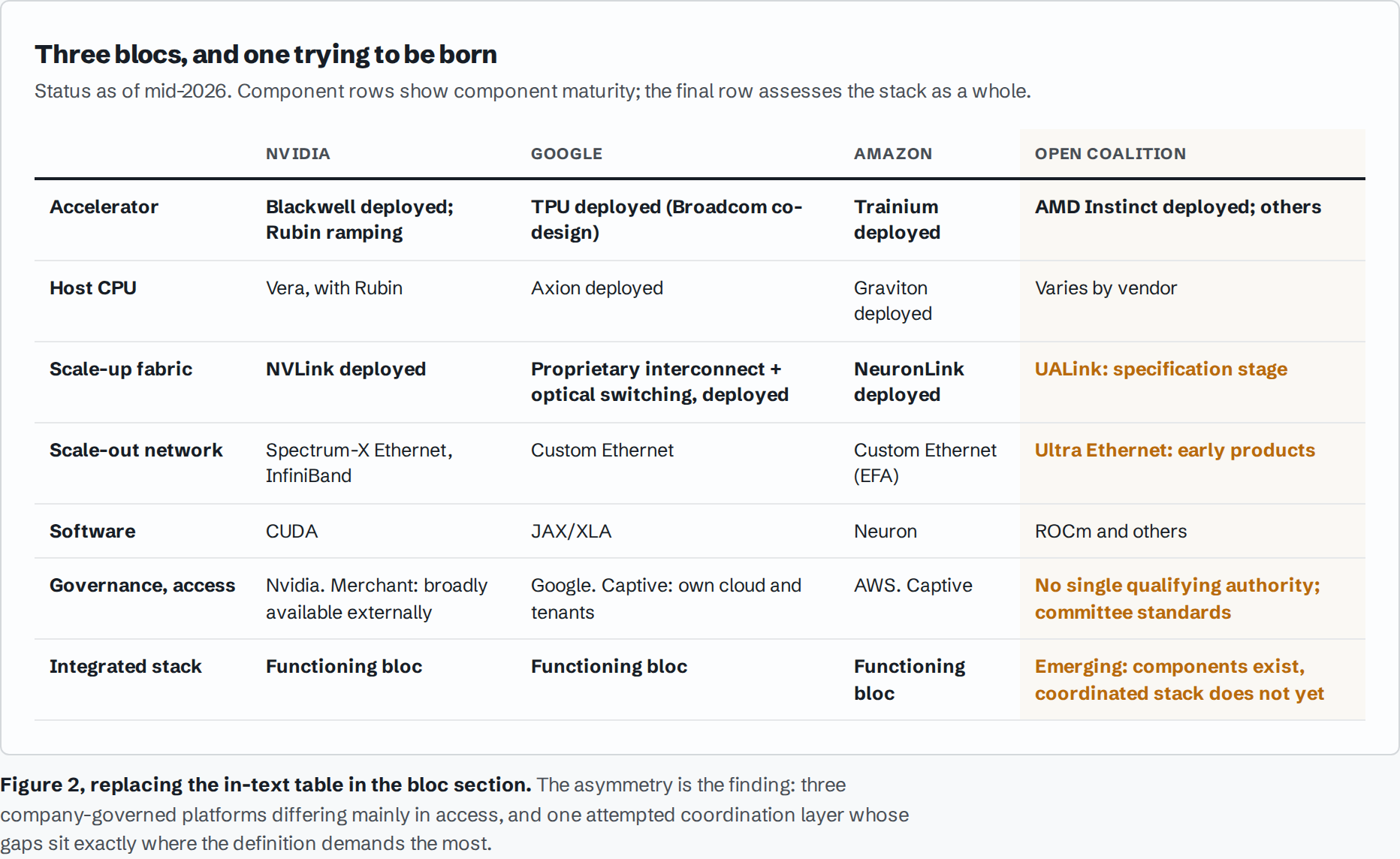
The table's asymmetry is the finding. Three columns are company-governed platforms differing mainly in access: Nvidia's stack is the only one broadly for sale externally. Within the real limits of export controls and allocation. While Google and Amazon govern captive stacks and still import the merchant platform for tenants and workloads their own silicon serves less well. The fourth column has deployed components and an undeployed whole; its gaps sit exactly where the definition demands the most: qualifying authority and repeat production of a coordinated stack.
Where does that leave Microsoft and Meta? No single layer makes a bloc, and bloc-ness is a maturity spectrum rather than a membership test: silicon programs, software environments, and coalition seats all count, and admission to a system runs through packaging, protocol, software, and commercial authority besides the fabric. But the scale-up fabric is the strongest single indicator, the diagnostic this series uses, because it is the layer where membership is decided: whoever governs the accelerator-domain interconnect determines which silicon can join a system. Both companies hold several bloc features and lack that one, along with repeat production of a governed stack of their own: partial bloc builders.⁵ The economic consequence of the whole map: a supplier's demand model becomes a sum across blocs, conditioned on qualification, with the arithmetic arriving at the lenses below.
All of them stand on the same constrained base
Beneath the blocs, one shared layer. Call it the substrate, defined broadly: not the packaging laminate but the constrained base of the whole contest, from leading-edge foundry capacity and advanced packaging through the three-vendor HBM supply, optical components, power equipment and grid interconnection.⁶ The flagship accelerators named in the table are all fabricated at TSMC; the major HBM vendors qualify across rival stacks; and every bloc's build-outs draw on the same constrained pool of transformers and interconnection approvals, though the queues are local, not one line.
What shared ground protects against, for a broadly qualified stream, is the identity of the winner: a stream exposed to both sides of a share shift can collect whether the shift favors Rubin racks or TPU pods. Which is exactly what a stream qualified into one stack cannot say. The protection belongs to breadth, not to location alone; a supplier can sit beneath every bloc and still be concentrated in one customer, one architecture, one node.
What it does not protect against is everything else. Architectures differ in die size, packaging intensity, HBM per accelerator, optical content, and power draw, so a share shift can move substrate demand even when end demand holds. The umbrella names a location, not a uniform risk profile; foundry, packaging, memory, optics, and power carry different qualification breadth, pricing power, and capital cycles. And the substrate's master exposure is the aggregate bet itself: whether AI capex converts into AI revenue, the convoy problem Part 1 opened and nothing since has closed.
Why the walls leak
Now the interpenetration from the opening: Anthropic's three platforms, Fusion's announced opening of Nvidia racks to Trainium.⁷ The "walls leak" because actors on both sides of them profit from the leaks.
Buyers resist unnecessary dependency, for two reasons that outlast scarcity.
The bargaining reason: exclusivity at this scale concedes pricing power, and sophisticated buyers avoid volunteering it unless compensated with performance, capacity guarantees, or economics.
The engineering reason: workloads are heterogeneous, and different platforms genuinely win different jobs, which makes multi-platform fleets a matter of fit rather than only leverage.
The two kinds of buyer express it differently. A frontier lab like Anthropic practices nonexclusive procurement: deep partnerships, real capital ties, and no single supplier holding exclusive control of its compute. The Cold War's non-aligned states are a loose analogy for the bargaining position, not a description of the contracts. A hyperscaler is a different creature, simultaneously customer, cloud supplier, chip designer, and bloc architect; Google committing Gemini partly to Nvidia systems is a bloc owner importing the rival platform.
Owners profit from selective openness.
Nvidia's Fusion program admits rival silicon by design, because tenancy would preserve its fabric and rack authority: the strategy Part 3 described, still an announced program whose deployments will test it. The clouds stock Nvidia for tenant demand, workload fit, and time to deployment; refusing the merchant platform would concede all three. The leaks are not lapses in bloc discipline; they are bloc strategy.
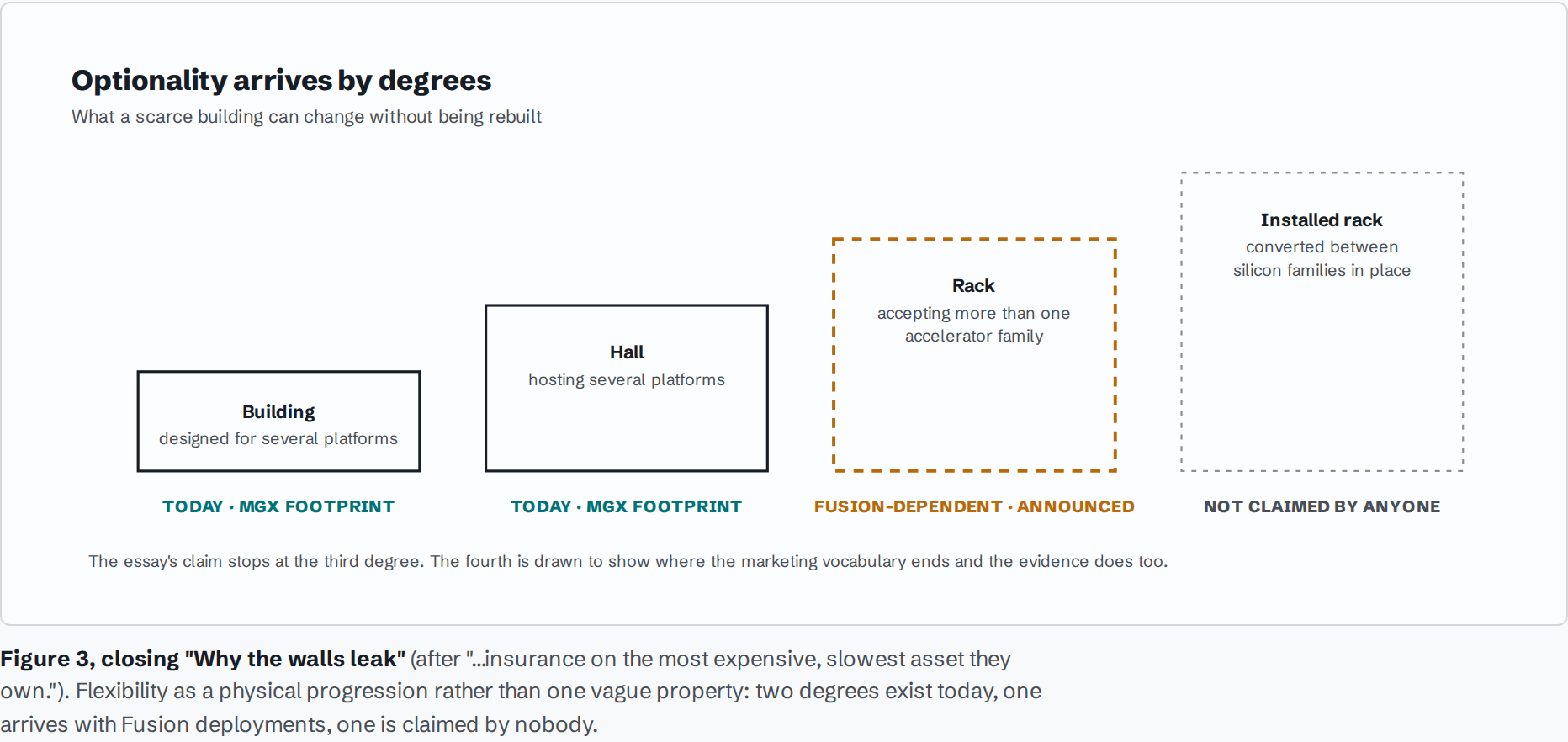
And scarce facilities reward optionality. The binding constraint has rotated, as Part 1 traced, and for much of the industry it now sits at powered shells and interconnection queues. Though the binding point varies by geography and project. Heterogeneous fleets carry real costs, so mixed deployment is not inevitable; what scarcity raises is the value of architectures that let a scarce building change silicon without changing the building. Optionality arrives by degrees: a building designed for several platforms, a hall hosting several, a rack that can accept more than one accelerator, and, rarest, a deployed rack converted between silicon families. The standardized MGX footprint advances the first two today and points at the third; Fusion would deliver the third broadly once deployments arrive; nothing here claims the fourth. From the buyer's side it is insurance on the most expensive, slowest asset they own.
Three lenses on a revenue stream
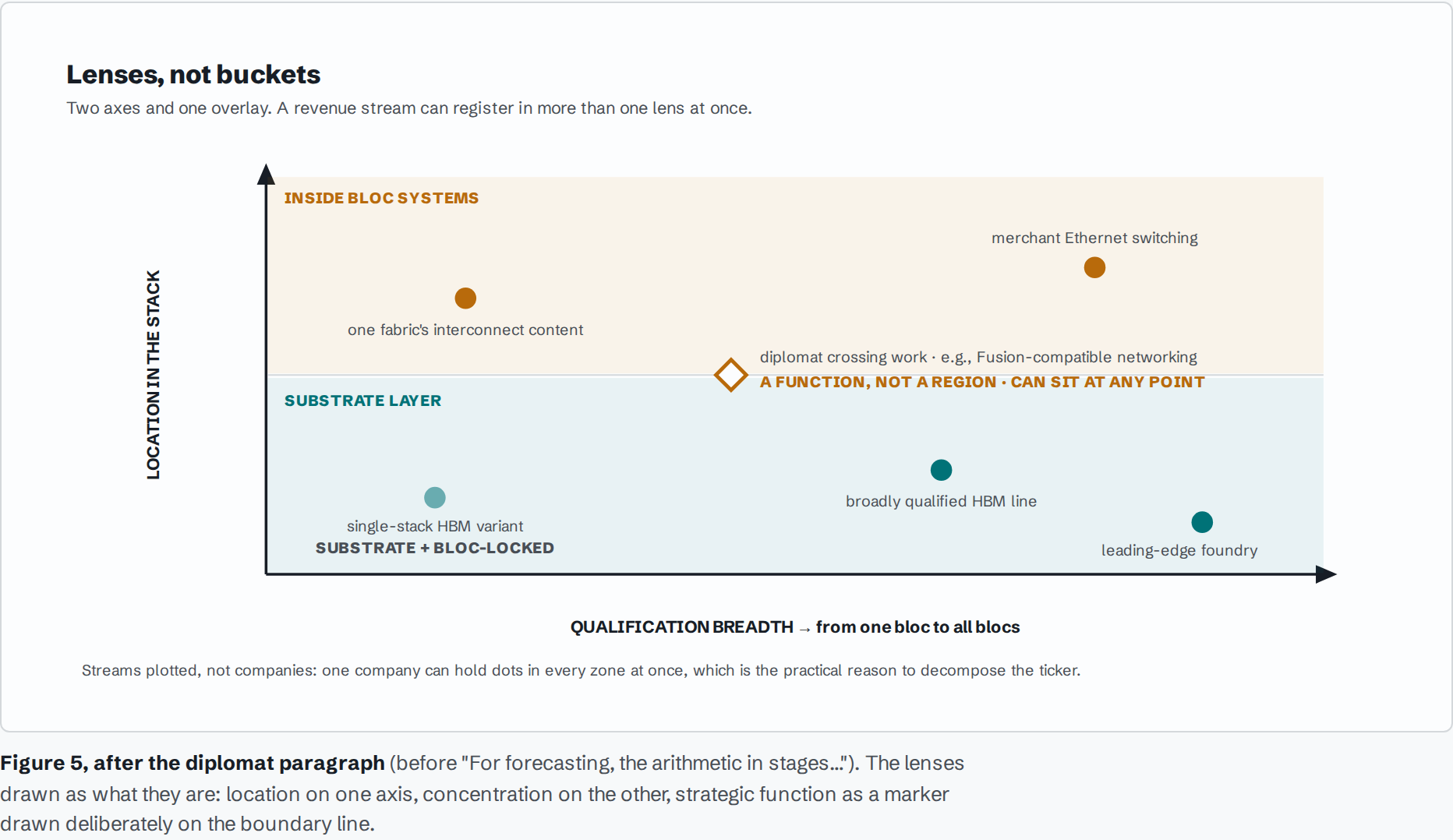
The map pays off as a way of reading a supplier: by revenue stream, not company, through three lenses that measure different things: location in the stack, concentration across blocs, and strategic function. A single stream can register in two lenses at once; an HBM line qualified into only one stack is substrate by location and bloc-locked by concentration, and knowing both is the point.
Substrate streams sit beneath the blocs and can collect across them; this is the position TSMC and the broadly qualified memory lines hold beneath all three platforms from the opening. Breadth of qualification defines the lens, and the advantage is the one the substrate section established: reduced architecture-winner risk, no more.
Bloc-locked streams rise and fall with one stack. They are the external-supplier counterpart of the closures the captured-demand section described: where capture extinguishes a merchant stream entirely, bloc-locking leaves the stream alive but hostage, through customer concentration, a single qualification, one fabric standard, or one software environment. The market's habitual error is pricing these streams on product merit while forgetting the alliance layer until a socket is lost at an annual refresh, or a standards body one does not sit on decides otherwise.
Diplomat streams would monetize the crossings themselves, and the conditional matters: this is the map's hypothesis, not yet its established segment. The candidate case is Marvell: two billion Nvidia dollars of investment capital, which is financing rather than revenue, directed at custom silicon and Fusion-compatible scale-up networking.⁸ Some of that work serves single-bloc custom programs; some of it would exist only because governed systems must meet and stay compatible. Which kind dominates is precisely what separates a diplomat franchise from ordinary multi-client design services. The direct evidence would be products required because two architectures meet, and qualifications held across rival fabric regimes; revenue attributable to interoperability may never be separately disclosed, so customer counts and named cross-stack wins serve as proxies, imperfectly. Until the evidence arrives, treat the lens as a watch category with a real squeeze risk, internalized by bloc owners or commoditized by the very standards it helps establish.
For forecasting, the arithmetic in stages, so no variable is counted twice. Define a stream's gross content opportunity as its addressable dollar content per system, before any award. Then:
Expected exposure (pre-qualification) = bloc system volume × addressable content per system × ex-ante qualification probability.
After qualification, the probability resolves and the uncertainties change name: realized revenue depends on award share, allocation, and realized pricing against that addressable content. Margin turns any of it into profit and belongs to the valuation installment. The route, not the sector label, carries the risk.
What would update the map (in theory)
Each test names its claim, its bar, and its main confound. Supplier classes carry different order cycles and recognition lags, so every comparison below is within class and over trailing windows, not single quarters.
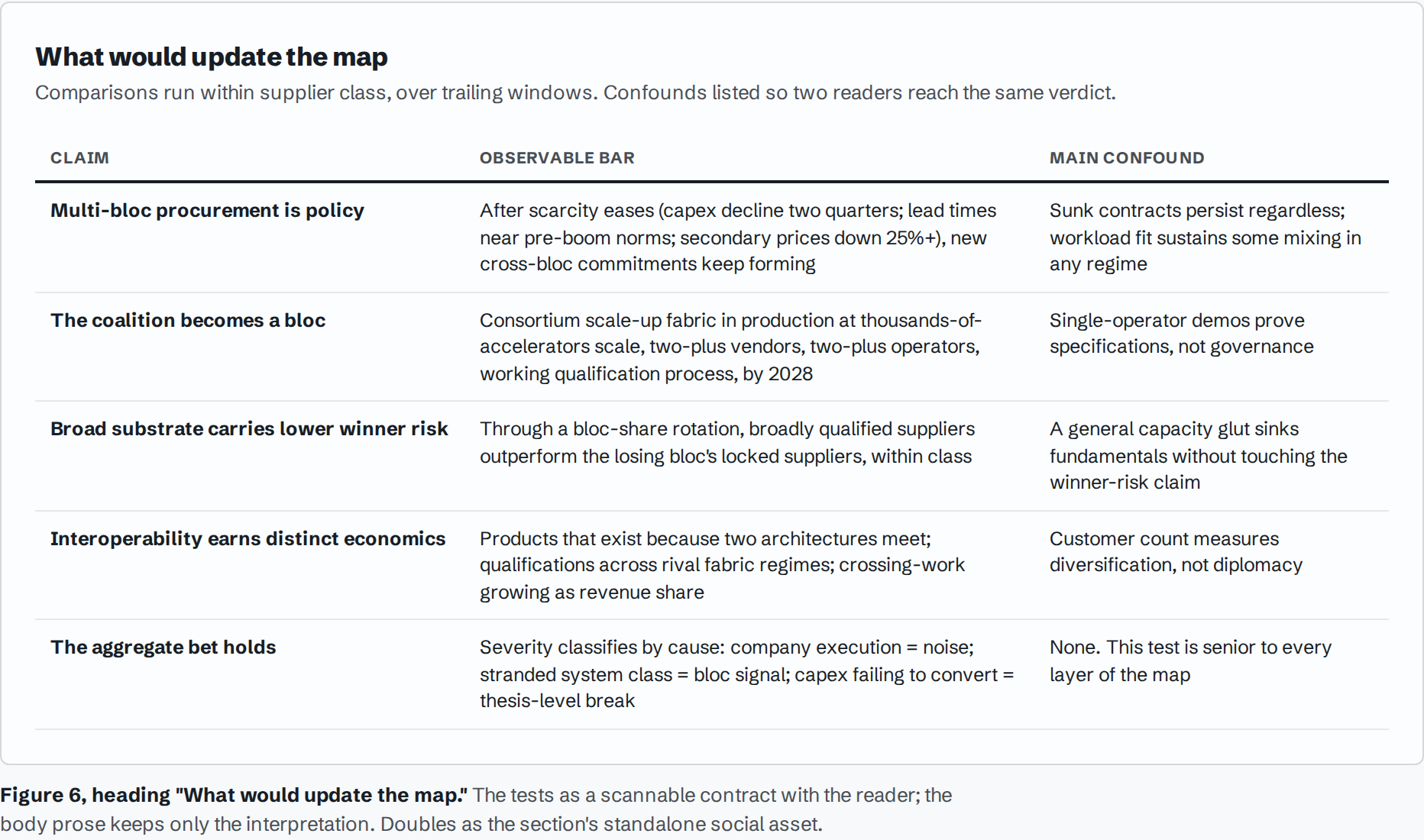
Multi-bloc procurement is policy, not scarcity behavior. Bar: after scarcity measurably eases (read the indicators as a basket, not a checklist: broad capex decline across two quarters, lead times near pre-boom norms, secondary prices for one-generation-old systems down 25 percent or more), new cross-bloc commitments and renewals keep forming. Confound: sunk contracts persist regardless; workload fit sustains some mixing in any regime. Read the pattern of fresh commitments, not any single deal.
The fourth column can become a bloc. Bar: a consortium-governed scale-up fabric (UALink or successor) in production at thousands-of-accelerators scale, implementations from two or more accelerator vendors, at more than one major operator, with production software support and a working qualification process (the full definition, not just the interface) by 2028. Vendor-specific software extensions are compatible with a functioning bloc; the absence of any qualification authority is not. Confound: single-operator demonstrations prove specifications, not governance.
Broadly qualified substrate streams carry lower winner risk. Bar: through a meaningful bloc-share rotation, broadly qualified substrate suppliers outperform the losing bloc's locked suppliers on revenue growth and utilization, compared within supplier class. Confound: a general capacity glut sinks substrate fundamentals without touching the winner-risk claim; the test is relative performance through a rotation, not absolute performance through a cycle.
Interoperability earns distinct economics. Bar, direct: products that exist because two governed architectures meet; qualifications held across rival fabric regimes. Bar, proxy: named cross-stack design wins and segment evidence that crossing-work grows as a share of revenue. Confound: customer count alone measures diversification, not diplomacy, and the proxies must not quietly substitute for the direct evidence.
And the aggregate bet holds. The convoy test, inherited, senior to every layer: severity classifies by cause. An impairment traced to one company's execution is noise; traced to stranded capacity of a system class, a bloc signal; traced to AI capex broadly failing to convert into revenue, the thesis-level break beneath blocs, substrate, and diplomats alike.
The resolution the opening promised: Anthropic was not confused, and neither was Google when it committed Gemini to a rival's racks. Both had read the map. Winning the accelerator comparison still matters. But it no longer settles where value accumulates, because between the winning chip and the collected dollar now sit routes, gates, and shared ground. Demand did not vanish, and declared allegiance does not reveal its destination. The route does.
What the map is worth is the remaining question: which streams are substrate priced as bloc-locked, which are bloc-locked priced as substrate, and what a diplomat franchise deserves if one truly exists. That is the final installment.
As always if you're here, thanks for reading. This one took some time.
#Nvidia #Amazon #Google #Gemini #CPU #TPU #GPU #AIHardware
Sources and confidence notes
Status labels: [D] deployed, [A] announced or committed, [R] roadmap.
Anthropic–Google expanded TPU agreement, announced October 2025: access to up to ~1M TPU chips, over 1 GW of capacity coming online through 2026. [A] Company announcements; unit and capacity figures are stated plans, not deliveries.
Anthropic–Amazon partnership and Project Rainier Trainium deployment (Indiana campus), 2024–26. [D/A mixed] The three platform relationships in the opening differ in form and disclosed size; the text does not equate their magnitudes.
Nvidia quarterly commentary, quarter ended April 26, 2026: Google Cloud to power Gemini workloads with Nvidia systems including Vera Rubin. [A] Deployment scale and timing not disclosed. "Longest-deployed custom AI accelerator" refers to TPU production use since ~2015; the criterion is longevity.
Vera Rubin NVL72 platform specification (72 Rubin GPUs, 36 Vera CPUs per rack): Nvidia materials. [A; ramping] AWS Graviton/Nitro and Google Axion deployment: vendor materials and analyst reporting at fleet level, as stated in the text. NeuronLink: AWS's published name for its Trainium chip-to-chip interconnect (Trainium2 UltraServer materials, 2024–25). [D]
Microsoft and Meta accelerator programs and open-coalition membership: company materials and analyst reporting. The maturity-spectrum classification and fabric-as-diagnostic reading are the author's.
"Substrate" here spans leading-edge foundry and advanced packaging, HBM supply, optical components, and power infrastructure, broader than the packaging-laminate meaning. TSMC fabrication of the named flagship accelerators: vendor materials and analyst consensus. The spot-price observation is the author's reading of allocation-era contracting described in Part 2's sourcing.
NVLink Fusion scope and AWS Trainium4 support: Nvidia and AWS statements, 2026. [A; no production deployments verified — all Fusion claims in the text are written to announced status.] Nvidia $2B investment in Marvell: company press releases, March 2026. [A]
Marvell custom-silicon and Fusion-compatible networking programs: company statements and analyst estimates. The "diplomat" reading is the author's hypothesis pending the crossing evidence described in the tests.