Construction Isn't Becoming Manufacturing. It's Becoming Something More Interesting.
For the last several years, one of the most common refrains in the industry has been that construction is "becoming more like manufacturing." You hear it at conferences, in investor decks, in contractor strategy memos, and from....
people who have never had to explain to an owner why a module arrived four inches off on a foundation poured to a drawing that changed twice after the shop tickets were cut....
The claim is directionally true. It is also over simplified.
Construction is not becoming manufacturing. It is becoming a hybrid production system. One that is learning, selectively and expensively, where it can afford to eliminate improvisation and where it still cannot.
The Real Change Isn't Prefab
Everybody knows prefab exists. That is no longer an insight. It is a procurement line item.
The actual shift is more fundamental: a reallocation of uncertainty. Traditional site-built construction is an open-loop system. Work gets assembled in variable conditions by variable crews, inspected late, and corrected expensively. The system tolerates remarkable improvisation because it was designed financially & contractually to absorb it.
That tolerance is now too expensive to maintain.
FMI estimates contractors lost between $30 billion and $40 billion to labor inefficiencies in 2022 alone. Skilled trades are not returning at the volume the industry needs. Owners building data centers, semiconductor fabs, and mission-critical facilities are not buying schedule tolerance as a feature. They have revenue to capture and capital sitting idle every week a commissioning milestone slips.
Under those conditions, the old model fails. Not philosophically. Economically.
So the industry is doing what industries do under pressure: moving the problem somewhere cheaper to solve. Earlier design freeze. Tighter tolerances. Factory QA instead of field rework. Repeatable assemblies that travel from fabrication to installation without the usual improvisation tax. That is manufacturing logic applied to project delivery. But it is not manufacturing.
Where the Analogy Holds
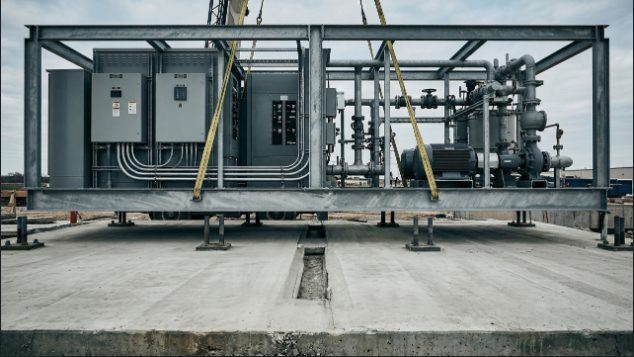
Look at how hyperscale operators are buying electrical infrastructure. Integrated skids, prefabricated switchgear rooms, modular power and cooling trains. These are no longer loose equipment orders. They are factory-integrated, factory-tested assemblies that arrive to site with documentation; test reports & defined connection points.
The manufacturing frame is honest here because the conditions support it: design repeats, interfaces hold, and the cost of delay is severe enough to force discipline upstream. Semiconductor fabs are further along this path than most people realize. Less through volumetric modules and more through intensive sequencing, utility prefabrication, and off-site assembly of process infrastructure. McKinsey's analysis shows East Asian fab construction routinely achieves volume production within 28 to 32 months of construction start. The gap between those projects and their U.S. counterparts is partly workforce, but mostly discipline: design maturity, interface control, and the kind of repeatable execution that comes from building the same thing at scale, many times over.
Where It Breaks
Buildings are not built in a factory. They are delivered to a site.
That site has soil conditions the factory never saw. Utility connections the factory never touched. A jurisdictional authority that does not negotiate with shop drawings. Local trades who inherited your module and have their own opinions about tolerance. None of that gets engineered away.
Construction also carries a structural disadvantage manufacturing doesn't: projects are assembled by temporary coalitions, not persistent teams. Manufacturing captures learning because the same people, running the same line, improve with every cycle. Construction largely resets that learning with each new project and contract. Real manufacturing discipline requires a production organization. Most of construction is still a network of temporary relationships that reassembles differently every time.
NAHB data shows off-site methods accounted for roughly 3% of completed U.S. single-family homes in 2024. A market that has been hearing the manufacturing story for twenty years and is still doing most of its work the old way, because the conditions that make industrialization pay off are not universal. You can move work into a warehouse and still run it like artisanal chaos with forklifts.
Risk Doesn't Disappear. It Migrates.
Less field labor risk. More upstream design freeze risk. Less on-site variability. More dependence on supplier performance and logistics execution. Fewer chances to absorb errors quietly in the field. More severe consequences when interface assumptions turn out to be wrong.... because those assumptions are now embedded in a finished assembly rather than scrawled on a whiteboard in a site trailer.
Here's the revised Risk Doesn't Disappear. It Migrates. section with the two case studies expanded:
Risk Doesn't Disappear. It Migrates.
Less field labor risk. More upstream design freeze risk. Less on-site variability. More dependence on supplier performance and logistics execution. Fewer chances to absorb errors quietly in the field. More severe consequences when interface assumptions turn out to be wrong — because those assumptions are now embedded in a finished assembly rather than scrawled on a whiteboard in a site trailer.
461 Dean Street in Brooklyn was supposed to be the proof of concept. Forest City Ratner partnered with Skanska to build a 32-story, 363-unit residential tower. At the time positioned as the tallest modular building in the world. With modules fabricated at the Brooklyn Navy Yard. The pitch was everything industrialized construction promises: factory precision, faster schedule, better quality. What they got instead was a factory that couldn't keep pace with site demand, modules stored outdoors long enough to suffer water damage, tolerance and interface problems that turned into field rework, and a project that hemorrhaged time and money before dissolving into litigation between Forest City and Skanska. The building got finished. The case for modular residential at scale did not. The lesson isn't that the idea was wrong. The lesson is that when you remove the field's ability to quietly absorb errors, the cost of being wrong upstream multiplies fast... and 461 Dean was wrong on several fronts simultaneously.
The Test Is at the Seam
The most honest thing you can say about industrialized construction is this: it tends to improve component quality. It often improves turnover quality. It does not fix what happens when systems meet.
Commissioning is where reality delivers its verdict on every upstream decision. Factory acceptance testing can verify that a skid performs to design requirements before it ships. It cannot simulate the live utility connection, the integrated controls sequence, the jurisdiction-specific acceptance condition, or the way three separate systems behave when asked to operate together under real load for the first time. UL states plainly that modular data center systems evaluated under its frameworks still require field evaluation of proper installation. Factory certification and field readiness are related. They are not the same thing.
The firms genuinely ahead in this transition understand this. They are not just building better modules. They are building better interface control, stronger FAT and SAT discipline, and commissioning workflows that begin at the design stage rather than after beneficial occupancy. They have stopped treating commissioning as a late-stage cleanup ritual and started treating it as the moment the whole upstream thesis gets tested against the physical world.
The seam is where the work gets judged. It always has been.
The Hybrid Wins
The future of construction is not a pure factory model. The economics, the logistics, the regulatory environment, and the nature of project delivery make that impossible at scale.
What is durable is something more specific: the ability to choose correctly. To know which scopes can be standardized, fabricated, and tested upstream like manufactured products. And which still have to be managed live, in the field, under conditions no factory can fully anticipate. The firms that build lasting advantage will be the ones that reduce improvisation where it's expensive and preserve judgment where it's necessary. That means manufacturing discipline upstream and something harder to systematize at the seam: the experience to know when your assumptions about the last connection point are about to cost you.
That is the real shift. Not construction becoming manufacturing. Construction becoming selective about where it still allows chaos and getting serious, finally, about the difference.