
Lululemon Grew Wider Than Its Control System
When a dominant company like Lululemon begins to wobble, the market instinctively points to the visible disturbances: a product miss, a CEO exit, a bad quarter, or a stronger rival.
Lululemon offers plenty of material for that kind of story. There was the "Breezethrough" stumble. There was the temporary pause on the "Get Low" collection after complaints about sheerness. There was the leadership turnover, the founder agitation, the awkwardness of a company trying to look stable while also trying to explain why stability suddenly required so much explanation.
All of that is real. But it is not the deepest thing going on.
Lululemon’s problem is simpler and more structural. The company grew wider and broader than the operating system that made it trustworthy.
That is the sort of sentence that can sound suspiciously neat, so it is worth slowing down and asking what it actually means.
When people use the phrase 80/20, they often mean nothing more than a crude ratio, as if the lesson were simply that a minority of products generate a majority of sales. But the more interesting version of 80/20 is not arithmetic. It is organizational. A business usually has a center of gravity: a small cluster of products, habits, standards, and customer expectations that does most of the invisible work. It carries trust. It creates pricing power. It gives the company permission to expand. And when management stops defending that center with enough discipline, the symptoms appear everywhere else.
Lululemon did not begin as a sprawling lifestyle platform. It began as a concentrated promise. The brand’s authority came from a narrow set of strengths: women’s performance apparel that felt technically superior, fit-and-fabric standards that seemed unusually exacting, a premium posture that depended on full-price credibility, and a store environment that made the brand feel less like apparel on a rack. But more like a belief system with seams. The point was never that Lululemon sold many things. The point was that it sold a few things with unusual conviction.
That is how premium brands work when they are working properly. They do not persuade the customer anew with every product. They establish a handful of mental shortcuts and then live off them. The garment will fit. The fabric will hold. The price, while irritating, will feel justified. The logo will signal not merely status but discernment. Products like "Align" did not just sell well. They taught customers what Lululemon was. Even something like the "Everywhere Belt Bag", which became a later breakout, worked because it floated on top of that deeper reservoir of trust.
The mistake, then, was not growth itself. It was forgetting which part of the business made growth safe.
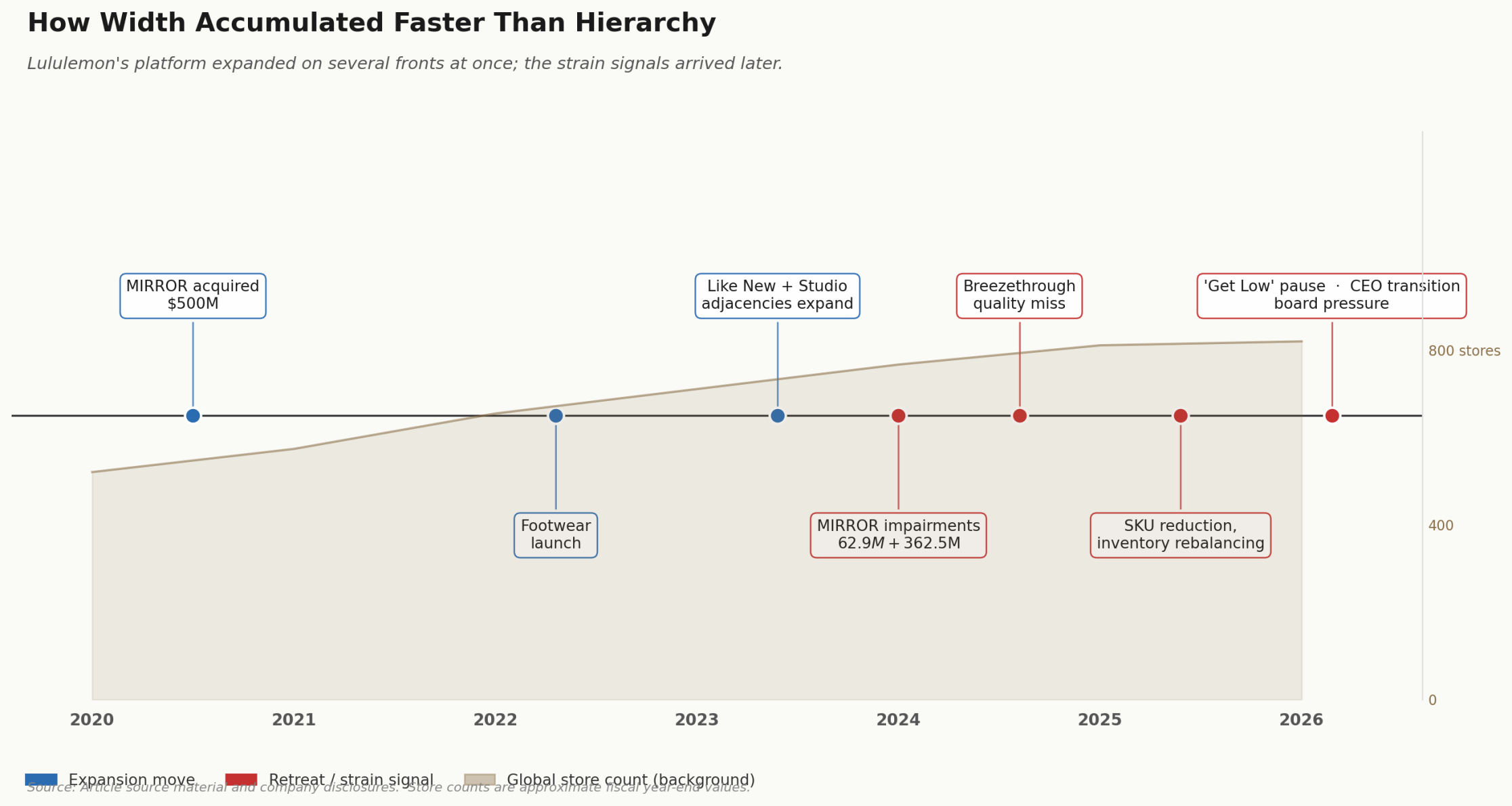
Some of Lululemon’s expansion was entirely sensible. Men’s was a real opportunity. International growth was and remains real. Digital was a rational extension of the brand’s reach. None of that was foolish. The trouble was cumulative. Width accumulated faster than hierarchy. The company added categories, channels, geographies, footwear, resale, outlet complexity, product breadth, and the sort of strategic adjacencies that always sound more coherent in the planning deck than in the income statement.
The cleanest example was MIRROR. In 2020, Lululemon bought the connected-fitness company for $500 million. At the time, the move could be narrated as bold, modern, ecosystem-building. Then came the write-downs: a $62.9 million hardware obsolescence charge, a $362.5 million goodwill impairment, additional restructuring costs, and eventually the end of the hardware story altogether. MIRROR mattered not merely because it failed. Companies survive failed bets all the time. It mattered because it revealed a particular kind of managerial temptation: the temptation to believe that once a brand becomes beloved, almost any extension of that brand counts as leverage.
It does not. Sometimes it is just drift with a PowerPoint.
The more revealing evidence, though, sits closer to the center of the business.
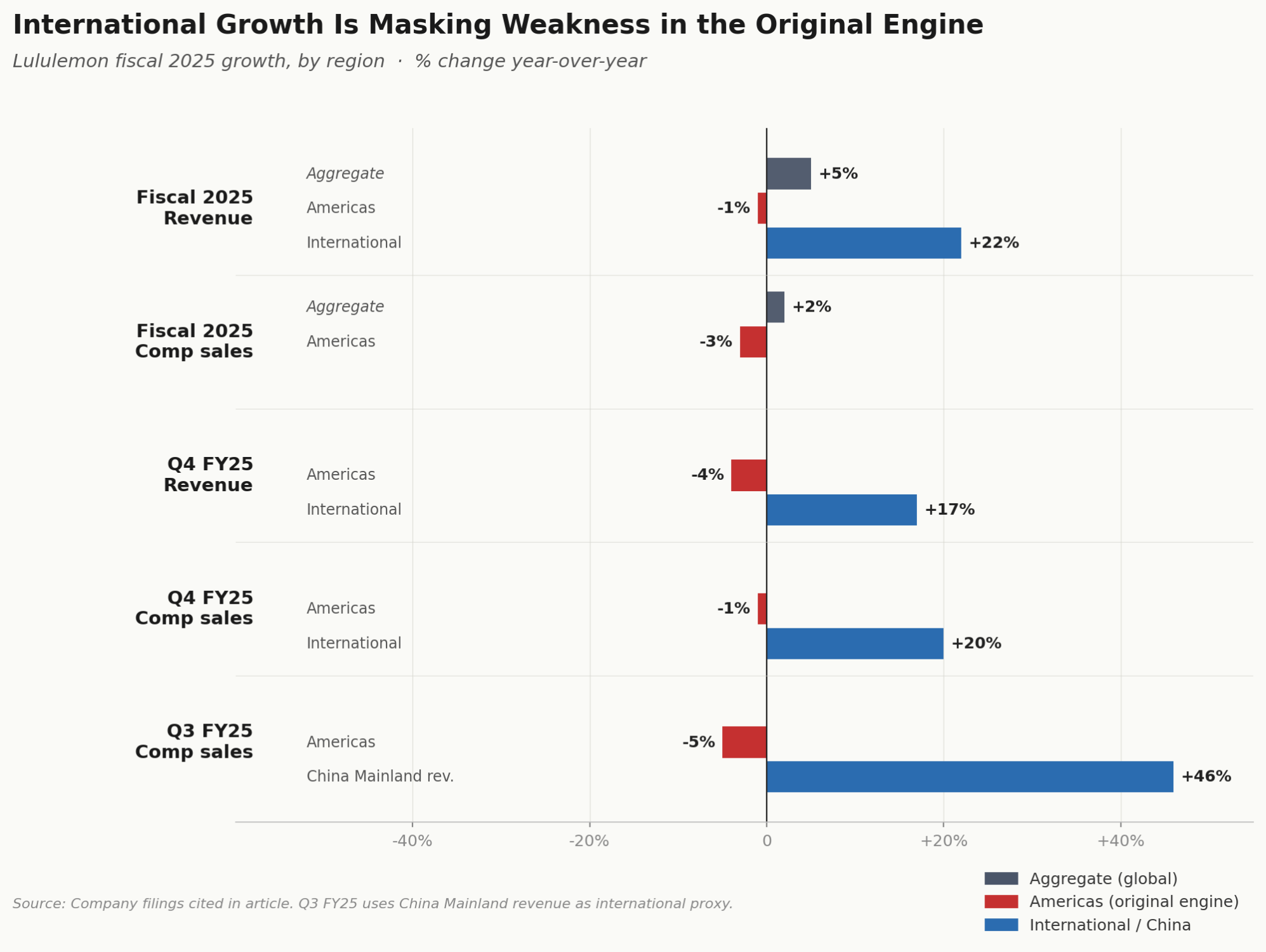
Fiscal 2025 revenue rose 5% to $11.1 billion. International revenue rose 22%. Comparable sales rose 2%. The company ended the year with 811 stores. Those are respectable numbers, and they explain why the story is easy to misread. In aggregate, Lululemon still looks like a large global platform with room to grow.
But aggregates are where structural problems learn to hide.
The split underneath the aggregate is the real story:
In fiscal 2025, Americas revenue fell 1% and comparable sales fell 3%.
In the fourth quarter, Americas revenue fell 4% and Americas comps fell 1%, while international revenue rose 17% and international comps rose 20%.
In the third quarter, Americas revenue fell 2% and Americas comps fell 5%, while China Mainland revenue rose 46%.
That geographical split matters more than the headline revenue line. The market that built the brand, trained the customer, and established the core economics is softening even as the rest of the machine keeps moving. International growth is not irrelevant. It is precisely what makes the problem easy to underestimate. When the original engine weakens inside a still-growing global business, management gets the dangerous gift of ambiguity.
Then there is the margin story.
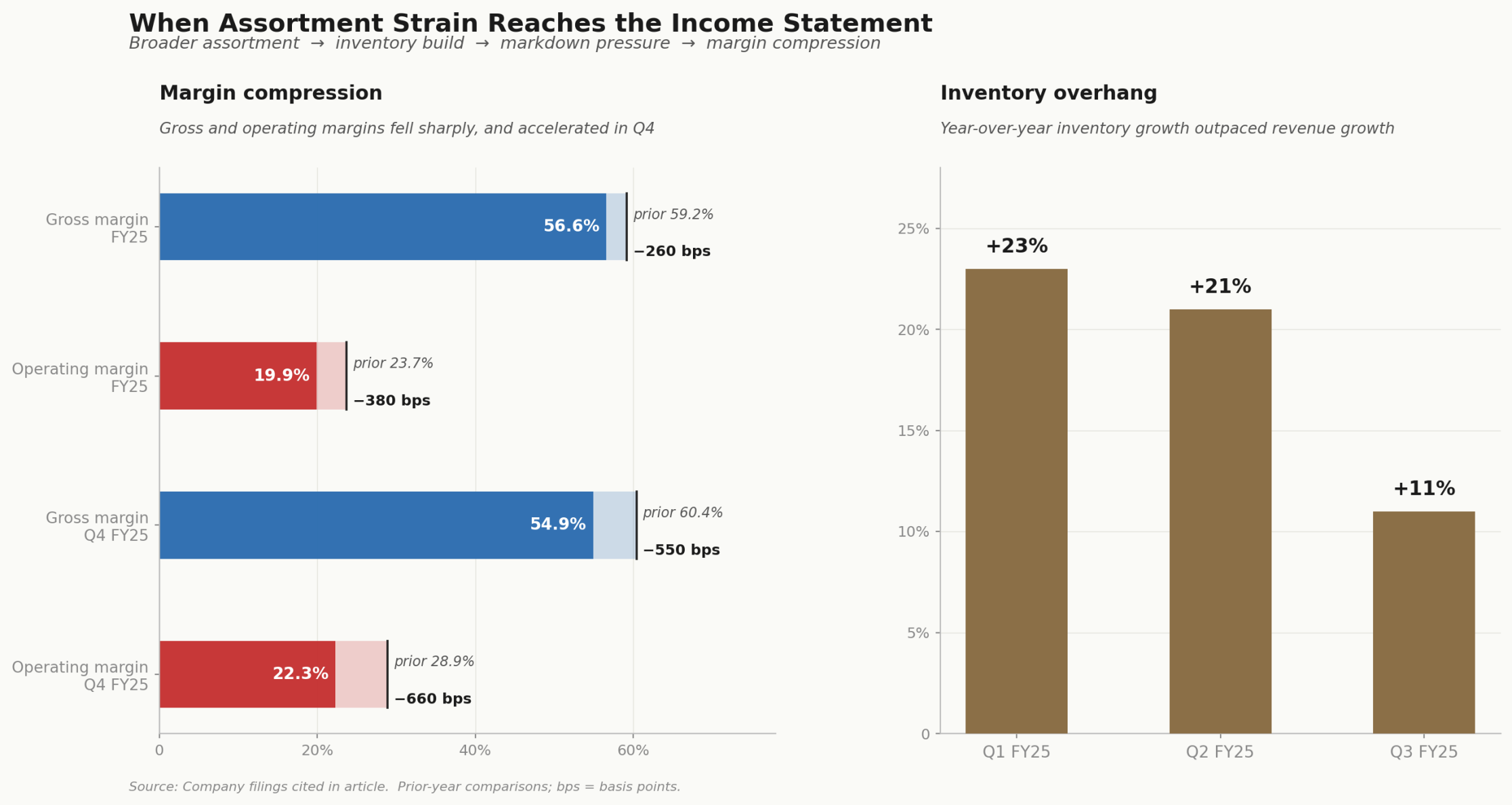
Fiscal 2025 gross margin fell 260 basis points to 56.6%. Operating margin fell 380 basis points to 19.9%. In the fourth quarter alone, gross margin fell 550 basis points to 54.9%, while operating margin fell 660 basis points to 22.3%. That is what strain looks like when it leaves merchandising and enters finance. When a premium retailer has to work harder to clear inventory and recover full-price selling, margin is where the strain stops being conceptual and starts becoming expensive.
Inventory tells a similar story, and in retail, inventory is often where strategic confusion first becomes measurable. Inventories were up 23% year over year in the first quarter of fiscal 2025, 21% in the second quarter, and 11% in the third. Lululemon also operates 52 outlet stores, mostly in the Americas. None of those facts is scandalous on its own. Together, alongside weaker North American comps and management’s renewed emphasis on full-price recovery and inventory rebalancing, they suggest a business carrying more assortment and more complication than its core demand is comfortably absorbing.
The product incidents matter for the same reason. The Breezethrough issue in 2024 was not catastrophic in the way the black Luon episode was in 2013, but that is almost beside the point. Nor was the temporary pause on Get Low in early 2026. The significance lies less in the isolated severity of each event than in their location. They occurred in the part of the business where Lululemon can least afford imprecision: women’s apparel, where the brand’s technical authority was originally forged. Management’s own admissions made the picture sharper. Missed opportunities in women’s. A core leggings color assortment that was too narrow. Spring launches that were too slow.
That is not random bad luck. That is a company losing exactness in the category that made it famous.
This is where the 80/20 frame becomes genuinely useful.
Every business has a top-left corner, whether or not anyone bothers to draw the matrix. There are high-value customers and high-value products. There are the combinations that carry disproportionate trust, margin, and meaning. Then there is everything else: support products, transactional volume, edge categories, experimental adjacencies, the long tail that can be worthwhile in moderation and disastrous when it starts pretending to be strategy.
Lululemon’s original strength came from managing that hierarchy well. The core products were not merely top sellers. They were protected differently. They received the best design attention, the most exacting standards, and the clearest internal understanding of what failure would cost. The rest of the assortment existed around that core, not on equal terms with it.
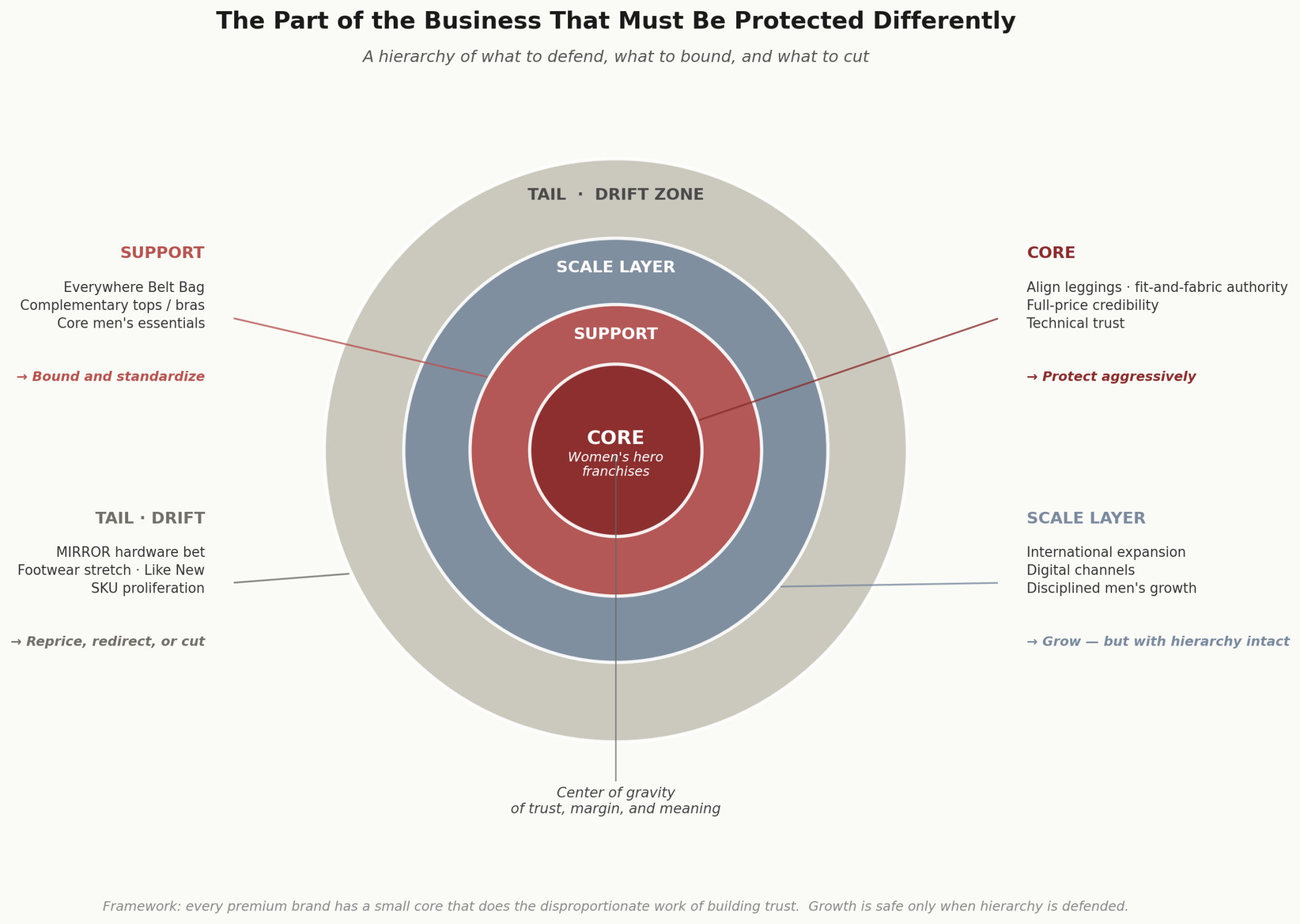
What changed is not that Lululemon developed a tail. Every successful brand has one. What changed is that the tail began to consume too much oxygen. By 2026, public product-card counts on the site showed 1,638 women’s apparel items and 913 men’s apparel items on major landing pages alone, before bags, accessories, shoes, sale pages, or local duplication even enter the frame. Those are imperfect proxies for SKU count, but they are vivid proxies. They tell you that the business is trying to carry vastly more breadth than the earlier brand needed in order to matter.
And breadth is not free. Breadth complicates demand planning. It raises the cost of forecasting errors. It stretches launch discipline. It creates more ways for a premium brand to disappoint the customer while still telling itself it is innovating.
None of this means that quality problems and leadership changes are irrelevant. It means they belong in the right place in the causal chain.
Quality issues are not the root explanation. They are what strategic drift looks like once the customer can feel it in their hands. If your brand is built on technical trust, then every miss in women’s bottoms or core apparel does more than create returns. It damages the mental shortcut that made the premium feel reasonable. Leadership churn works the same way. A CEO transition matters, and the December 2025 announcement that Calvin McDonald would step down, with Marti Morfitt moving into the executive chair role and Meghan Frank plus André Maestrini becoming interim co-CEOs, was not trivial. Neither was Chip Wilson’s campaign for board change. But leadership instability is most dangerous when the operating model underneath it is already less coherent than it used to be.
The strongest objection to this argument is also the most interesting one. Perhaps Lululemon did not stop defending its core. Perhaps the core itself stopped being special. Maybe Alo, Vuori, Beyond Yoga, and Rhone really did close the gap. Vuori has been especially strong in comfortable everyday performance wear. Alo has been effective at pressing on the brand’s premium, style-forward credibility. Beyond Yoga and Rhone each chip away at adjacent parts of the premium activewear map. Maybe fit-and-fabric authority is simply more contestable now than it was a decade ago.
There is almost certainly some truth in that. Competition is stronger. The category is noisier. The consumer is less captive. But that does not weaken the 80/20 argument. It sharpens it. When the moat narrows, the job of protecting the few remaining things that still differentiate you becomes more urgent, not less. That is exactly when you do not want your women’s business missing on timing, color depth, sheerness, or product newness. It is exactly when you do not want organizational attention scattered across too many edges of the map.
Which brings us to the most telling part of the story: the company’s own language about recovery. SKU reduction. Inventory rebalancing. Faster insertion of winning product in North America. Better full-price selling. More newness where it matters. Those are not the phrases of a business suffering from one unlucky quarter. They are the phrases of a business trying to restore hierarchy after a period in which too many things were allowed to matter at once.
The market, unromantic as ever, seems to understand this. On April 20, 2026, Lululemon shares traded around $165.79, implying a market capitalization of roughly $19.35 billion and a price-earnings ratio near 11.3. Recent reporting described the stock as down roughly 37% to 38% over the prior year and about 22% year to date. Investors are not merely discounting tariffs or one-off noise. They are wrestling with the possibility that the company’s original engine is less defended than the consolidated numbers make it appear.
That is the uncomfortable truth hidden inside the still-growing global story. Lululemon can keep producing respectable aggregate results for a while. International growth can continue. The platform can keep expanding. But if the original engine loses authority, aggregate strength stops being proof of health and starts functioning as camouflage.
Lululemon did not lose its edge all at once. It diluted the conditions that made the edge believable. The company stopped defending the small set of products, standards, and disciplines that made all its subsequent growth safe. And that kind of problem can look fine in the aggregate, right up until the exact moment it does not.