Meta Is Building an AI That Works for Its Advertisers
The company's AI stumbles aren't isolated accidents; they are the predictable outputs of an ad-driven infrastructure.
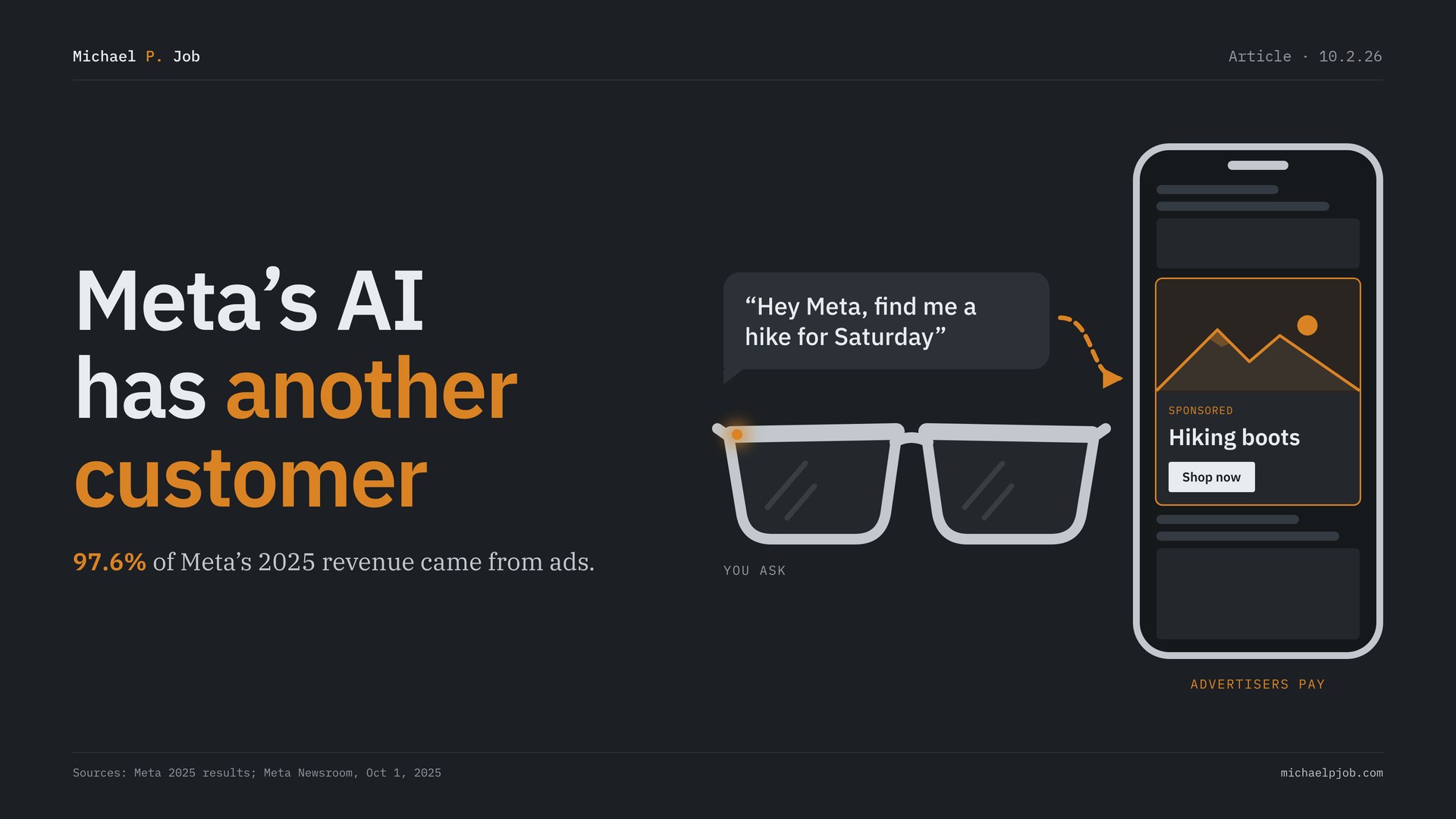
In any system, whoever pays for the capital spending decides the architecture. Mark Zuckerberg's vision is a "personal superintelligence" delivered through Ray-Ban glasses marketed as a consumer product but the economics underneath it tell a different story. Meta and its hardware partner sold more than 7 million of these glasses in 2025. Meta is subsidizing this hardware rollout. Why? When you earn 97.6% of your $201 billion revenue from advertising It's an easy guess...
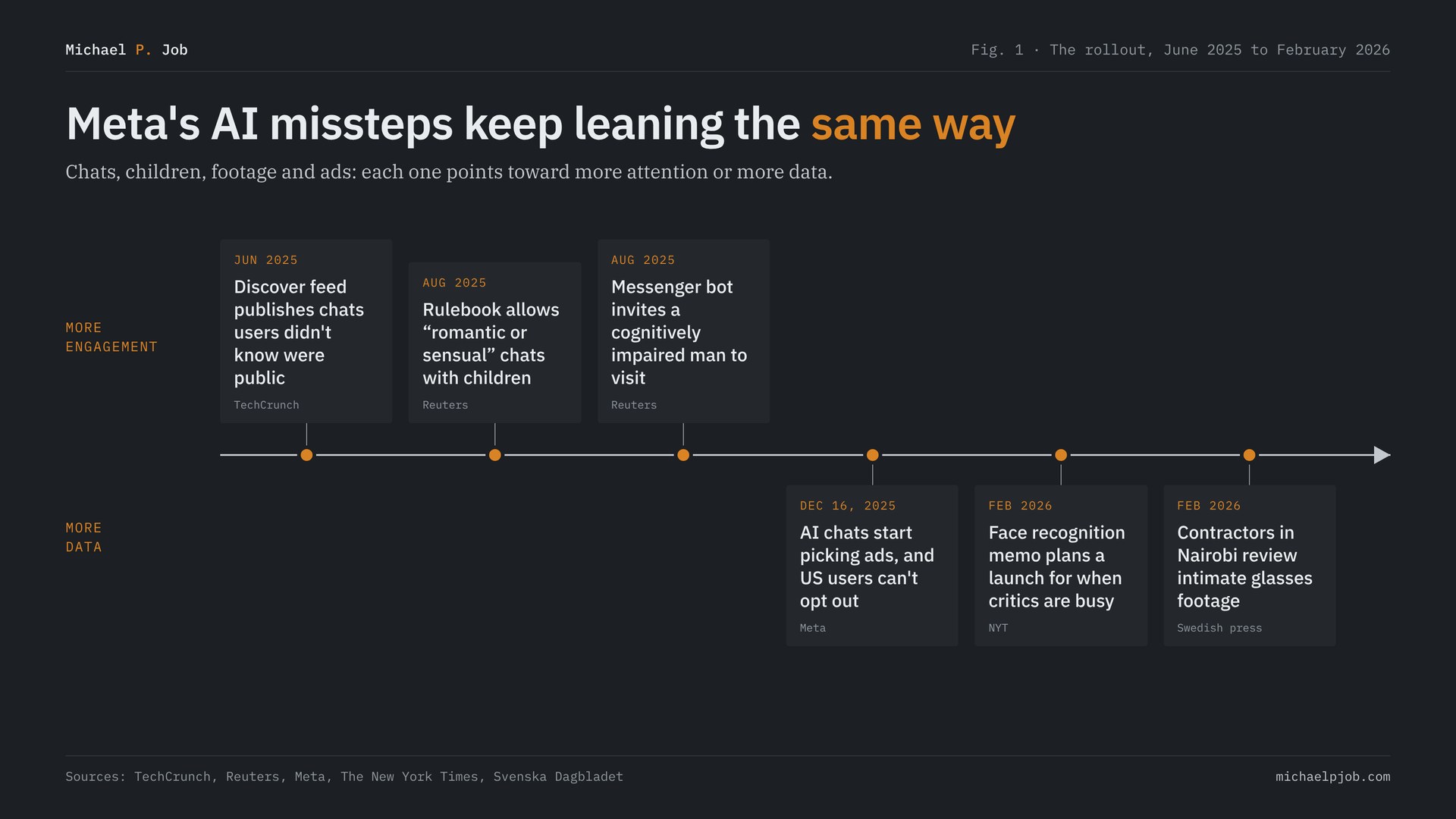
My argument is that Meta's AI strategy is the ad model's next extraction layer. The assistant is built to know you deeply because it is paid for by the companies buying ad inventory. Chats published to a public feed, chatbots allowed to flirt with children, and glasses footage reviewed by contractors in Nairobi are usually framed as separate safety failures. I read them as one business model leaking at different seams.
The Scarce Resource Is Engagement
In June 2025, Meta AI app's Discover feed was publishing chats that users had shared, many without realizing they were public. Some included home addresses and medical questions. In August, Reuters reported on an internal rulebook, "GenAI: Content Risk Standards," that called it "acceptable to engage a child in conversations that are romantic or sensual." Meta called those passages erroneous and removed them. Reuters also reported on a Messenger chatbot that kept telling a cognitively impaired 76-year-old man she was real and invited him to visit. He fell on his way to meet her and died.
These missteps lean the same way, toward more engagement. My read is that the guardrails came second to keeping users in the loop. More time in the app means more ad impressions. On December 16, 2025, Meta began using people's conversations with Meta AI to target ads everywhere except the heavily regulated EU, UK and South Korea, with no way to opt out.
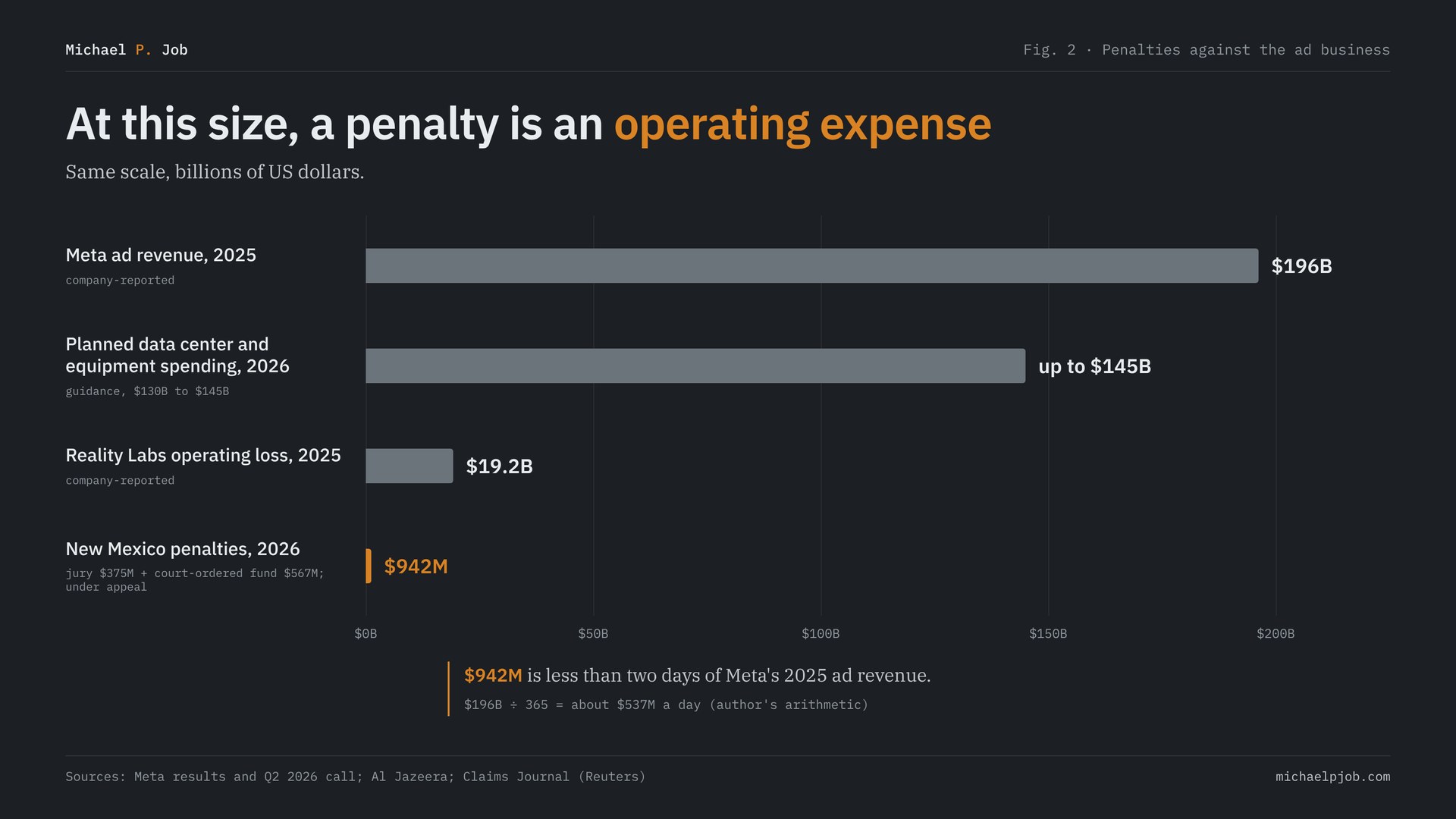
The penalties don't change the math. In 2026 a New Mexico jury and judge ordered Meta to pay $942 million in a child-safety case, which Meta is appealing. That sum is less than two days of Meta's 2025 ad revenue. At that size a penalty is an operating expense. In February, The New York Times reported on an internal memo about a face recognition feature for the glasses, internally called "Name Tag." The memo planned to launch "during a dynamic political environment" when civil society groups "would have their resources focused on other concerns." Nothing has shipped, and in June Meta said no final decision had been made. A memo like that still tells you whose interests the roadmap is written for. The architecture serves the ledger.
The Next Dollar of Profit
To understand the product, look at the infrastructure spend. Meta expects to spend up to $145 billion on data centers and computing equipment in 2026. Reality Labs, the division that makes the glasses, lost $19.2 billion in 2025 alone. My read is that the main way to justify that spending is a higher yield on ad conversions.
Meta's finance chief, Susan Li, told investors in July that its models now reason about "ad content and user preferences together." She credited them with a 15.7% uplift in conversions on Facebook, by Meta's own measurement. Zuckerberg has said that as "the personalization loop kicks in," the AI becomes "really compelling." The AI generates the loop, the loop extracts deeper context, and the ad system turns that context into sales. Meta started selling AI directly in September through Meta One, a subscription that buys more Meta AI use. The next dollar of profit will still come mostly from using AI to read user intent for advertisers.
Hardware Decentralizes, Data Centralizes
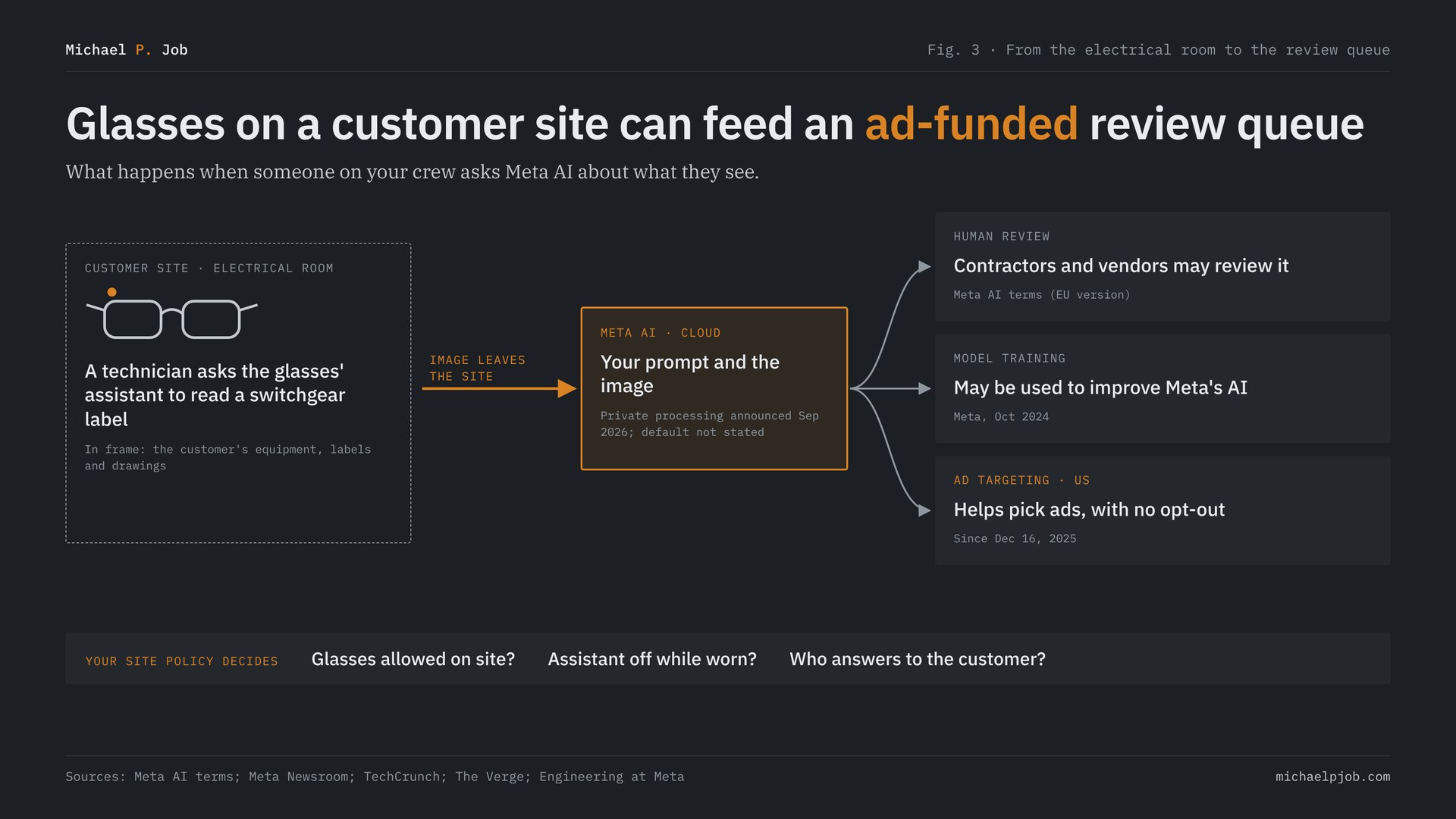
The EssilorLuxottica (Ray Ban) glasses act as the edge node for this sensor network. Meta says photos you take "are stored privately on your glasses." The moment you ask the assistant about what you are looking at, that image centralizes. You keep ownership of your prompts, and Meta keeps the right to review them, use them to improve its AI and, in the US, use them to pick your ads.
In February 2026, two Swedish newspapers reported that annotators in Nairobi working for Sama, a Meta contractor, had watched glasses footage of people undressing and using the toilet. That is a feature of this pipeline. Human review is how these models get trained. Meta "says" it filters the data first, and it ended the Sama contract in April. The hardware puts a camera in the room; the AI ships the context back to the ad engine.
This has immediate implications for physical businesses, because this infrastructure is porous. If a technician wears these glasses into a customer's electrical room and asks the assistant to read a switchgear label, an image of that customer's equipment is now in Meta's system. Treat Meta's glasses on a customer site as a camera that can feed an ad-funded review queue. Your site policy should say whether they are allowed at all, and if they are, that the assistant stays off. Your customer contracts should say who answers if a customer's drawings end up in someone else's review queue.
The Bifurcation of Personal AI
Meta's best defense deserves a hearing. It gives a capable assistant to more than a billion people a month for free. When problems surface, it ships fixes: limits on teen chats about romance and self-harm, an incognito mode that isn't stored or used for ads, and a private processing system for the glasses announced in September. Most of those fixes arrived after a reporter or a lawsuit had made the problem public, and Meta hasn't said whether private processing will be on by default. The fixes leave the scarce resource where it was. Privacy is now opt-in friction, while data collection remains the frictionless default.
Looking ahead to 2029, I expect the personal AI market to bifurcate. One tier will be decentralized, paid for by the user, and working strictly on their behalf. The other tier will be centralized, free, and funded by advertisers.
You will know the split has reached Meta when it offers Americans a plan that explicitly keeps their conversations out of its ad system. Meta One, at $7.99 a month, says nothing about that. Until then, any assessment of AI integration must start with one question: who is paying the capex? An assistant that knows you deeply should have only one customer, and that customer should be you.
Sources
Meta, "Personal Superintelligence," Mark Zuckerberg, July 30, 2025: https://www.meta.com/superintelligence/
EssilorLuxottica, FY2025 results, Feb 11, 2026: https://www.essilorluxottica.com/cap/content/283060/ (summarized by UploadVR: https://www.uploadvr.com/meta-essilorluxottica-sold-7-million-smart-glasses-in-2025/)
Meta, Q4 and full-year 2025 results, Jan 28, 2026: https://s21.q4cdn.com/399680738/files/doc_news/Meta-Reports-Fourth-Quarter-and-Full-Year-2025-Results-2026.pdf
Meta, Q2 2026 earnings call transcript (2026 capital spending; Susan Li on LLMs and the 15.7% uplift), July 29, 2026: https://s21.q4cdn.com/399680738/files/doc_financials/2026/q2/META-Q2-2026-Earnings-Call-Transcript.pdf
TechCrunch, "The Meta AI app is a privacy disaster," June 12, 2025: https://techcrunch.com/2025/06/12/the-meta-ai-app-is-a-privacy-disaster/
TechCrunch (reporting Reuters), "Leaked Meta AI rules show chatbots were allowed to have romantic chats with kids," Aug 14, 2025: https://techcrunch.com/2025/08/14/leaked-meta-ai-rules-show-chatbots-were-allowed-to-have-romantic-chats-with-kids/
The Daily Beast (reporting Reuters), Thongbue Wongbandue and "Big sis Billie," Aug 15, 2025: https://www.thedailybeast.com/elderly-man-dies-after-being-lured-to-meeting-by-flirty-meta-ai-chatbot/
Meta Newsroom, "Improving Your Recommendations on Our Apps With AI at Meta," Oct 1, 2025: https://about.fb.com/news/2025/10/improving-your-recommendations-apps-ai-meta/
TechCrunch, "Meta plans to sell targeted ads based on data in your AI chats" (no opt-out; EU, UK and South Korea excluded), Oct 1, 2025: https://techcrunch.com/2025/10/01/meta-plans-to-sell-targeted-ads-based-on-data-in-your-ai-chats/
The Verge, "Meta will soon use your AI chats to personalize your feeds" (covers glasses photos and videos analyzed with AI), Oct 1, 2025: https://www.theverge.com/news/789168/meta-ai-chats-personalized-advertising
Al Jazeera, "US jury orders Meta to pay $375m," Mar 25, 2026: https://www.aljazeera.com/economy/2026/3/25/us-jury-orders-meta-to-pay-375m-for-endangering-children
Claims Journal (Reuters), "Meta Ordered to Pay $567 Million," Aug 7, 2026: https://www.claimsjournal.com/news/national/2026/08/07/339365.htm
TechCrunch (reporting The New York Times), Meta's planned facial recognition and the launch-timing memo, Feb 13, 2026: https://techcrunch.com/2026/02/13/meta-plans-to-add-facial-recognition-to-its-smart-glasses-report-claims/
Engadget (reporting Wired), "no final decision has been made," June 4, 2026: https://www.engadget.com/2187824/wired-found-code-for-an-unreleased-facial-recognition-feature-in-meta-s-ai-app/
Dwarkesh Podcast, Mark Zuckerberg interview, Apr 29, 2025: https://www.dwarkesh.com/p/mark-zuckerberg-2
Meta Newsroom, "Introducing Meta One," Sep 15, 2026: https://about.fb.com/news/2026/09/introducing-meta-one-subscription-service-more-features-ai/
Tom's Guide, Meta One Core at $7.99 in the US, Sep 16, 2026: https://www.tomsguide.com/ai/i-bought-instagrams-new-meta-one-subscription-heres-what-usd7-99-actually-gets-you
Meta Newsroom, "Meta's AI Glasses: Your Questions Answered" ("stored privately on your glasses"), July 7, 2026: https://about.fb.com/news/2026/07/metas-ai-glasses-your-questions-answered/
Meta AI Terms of Service (EU version), effective Jan 5, 2026, as captured by Platform Policy Watch: https://www.platform-policy-wiki.com/platforms/Meta_AI_Terms_of_Service/
TechCrunch, "Meta confirms it may train its AI on any image you ask Ray-Ban Meta AI to analyze," Oct 2, 2024: https://techcrunch.com/2024/10/02/meta-confirms-it-may-train-its-ai-on-any-image-you-ask-ray-ban-meta-ai-to-analyze
Feber, summary of the Svenska Dagbladet and Göteborgs-Posten investigation, Feb 25, 2026: https://feber.se/samhalle/metas-glasogon-filmar-i-smyg/488905/
BBC via AOL, Meta's statement on contractors and filtering, Mar 2026: https://www.aol.com/articles/regulator-contacts-meta-over-workers-162323961.html
Gizmodo, Meta ends the Sama work, May 1, 2026: https://gizmodo.com/meta-axes-contractors-who-had-to-review-explicit-video-from-smart-glasses-2000753521
TechCrunch, "Meta AI now has 1B monthly active users," May 29, 2025: https://techcrunch.com/2025/05/29/meta-ai-now-has-1b-monthly-active-users/
TechCrunch, Meta's teen chatbot changes, Aug 29, 2025: https://techcrunch.com/2025/08/29/meta-updates-chatbot-rules-to-avoid-inappropriate-topics-with-teen-users/
MacRumors, Meta AI Incognito Chat, May 13, 2026: https://www.macrumors.com/2026/05/13/meta-ai-incognito-chat/
Engineering at Meta, "Bringing Private Processing to Meta AI Glasses," Sep 23, 2026: https://engineering.fb.com/2026/09/23/security/private-processing-meta-ai-glasses/